An asylum officer can put an applicant under oath, question them for two hours, and decide the case largely on how consistent the answers were. Nothing in the rule requires anyone to write down what those answers actually were.
That would be a defensible design if the spoken word did not matter much to the outcome. It is harder to defend given what the same body of law does elsewhere: the same section of the same regulation requires a word-for-word transcript for a different interview down the hall, conducted by the same kind of officer under the same oath authority.
This is not a gap between agencies, or between a formal proceeding and an informal one. It is a gap between two adjacent paragraphs.
The Interview Is Under Oath. The Record Is a List of Documents.
Under 8 CFR 208.9(b), the asylum officer conducts the interview in a nonadversarial manner, and its purpose is to elicit all relevant and useful information bearing on the applicant’s eligibility. Under 208.9(c), that officer has authority to administer oaths and to question the applicant and any witnesses.
Read those two provisions together and the character of the event is unambiguous. This is sworn testimony, elicited by a government officer with questioning authority, on whether someone is sent back to a country they fled. Nonadversarial describes the tone of the room. It does not describe the stakes.
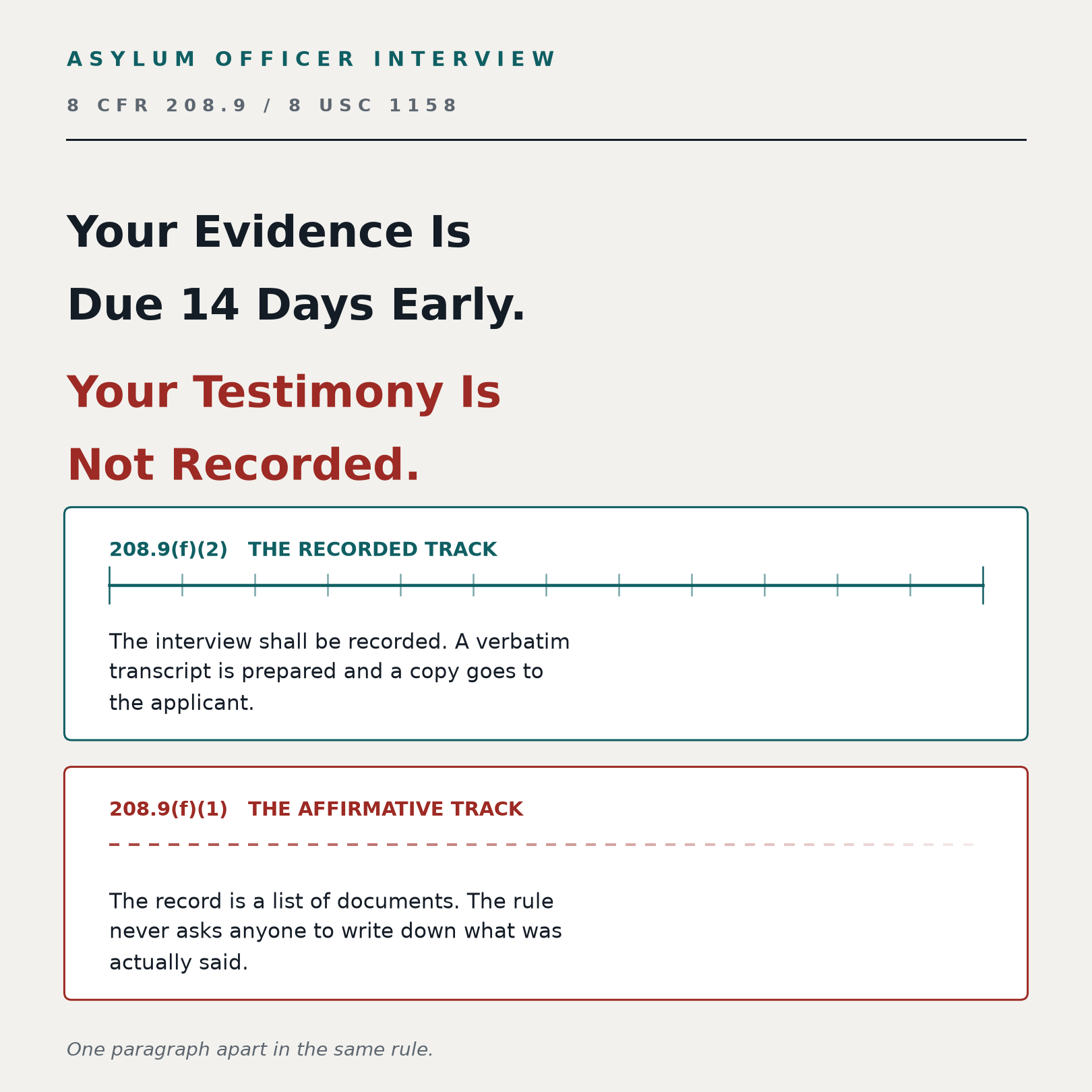
Then 208.9(f)(1) defines what counts as the record: the application, the supporting information the applicant provided, comments submitted by the Department of State or DHS, and any other unclassified information the officer considered in the written decision.
That is a list of paper. Every item on it existed before the interview began or was generated by the agency afterward. The spoken exchange that filled the room — the thing the officer was statutorily directed to elicit — is not on it.
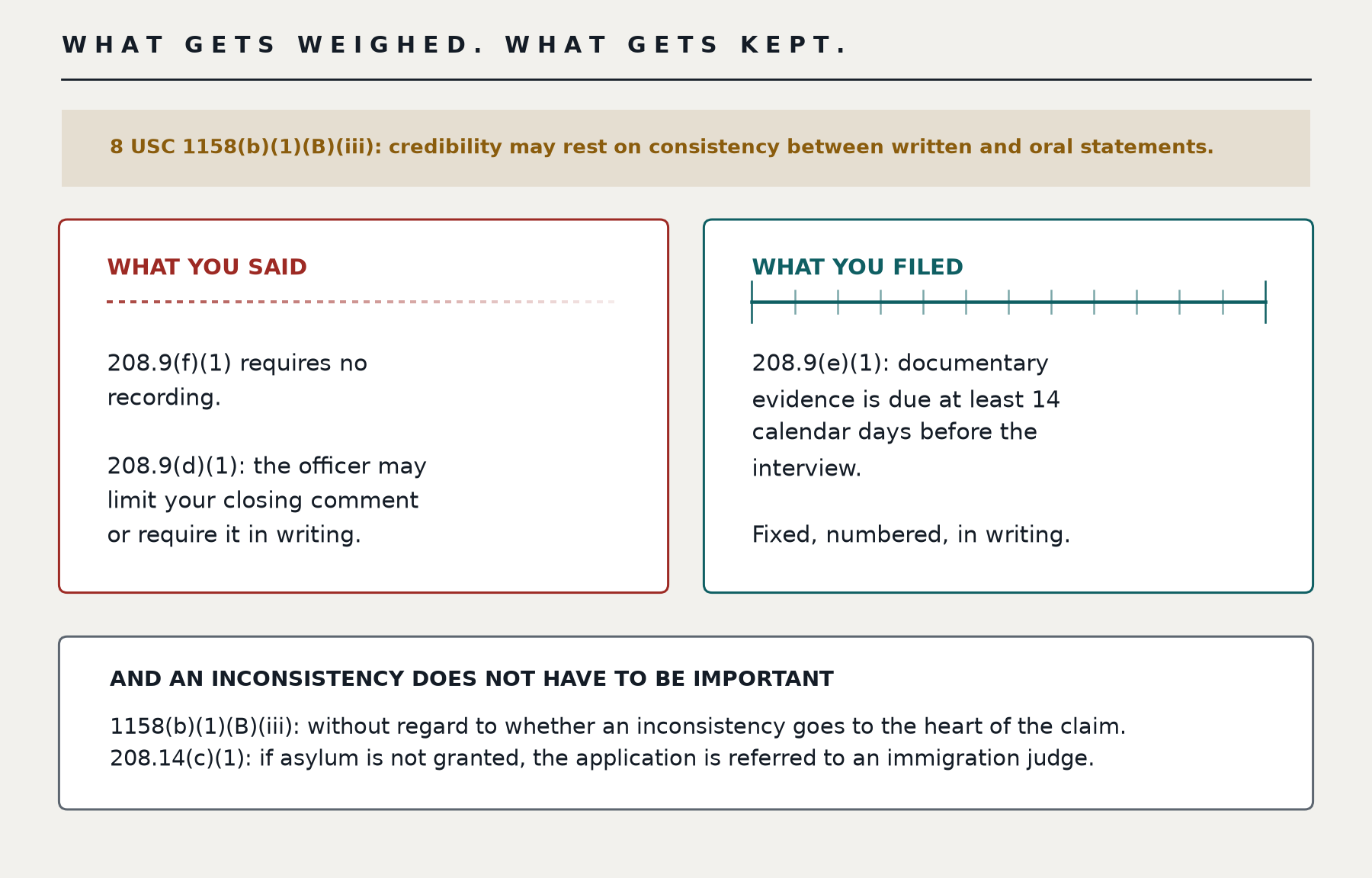
Meanwhile 208.9(e)(1) gives the documents a hard number: evidence is due at least 14 calendar days before the interview. The paperwork gets a deadline, expressed in calendar days, enforceable by anyone with a calendar. The testimony gets no record at all.
The asymmetry is the point. The regulation is perfectly capable of being specific about what must exist and when. It is specific about the exhibits. It says nothing about preserving the testimony those exhibits are offered to corroborate.
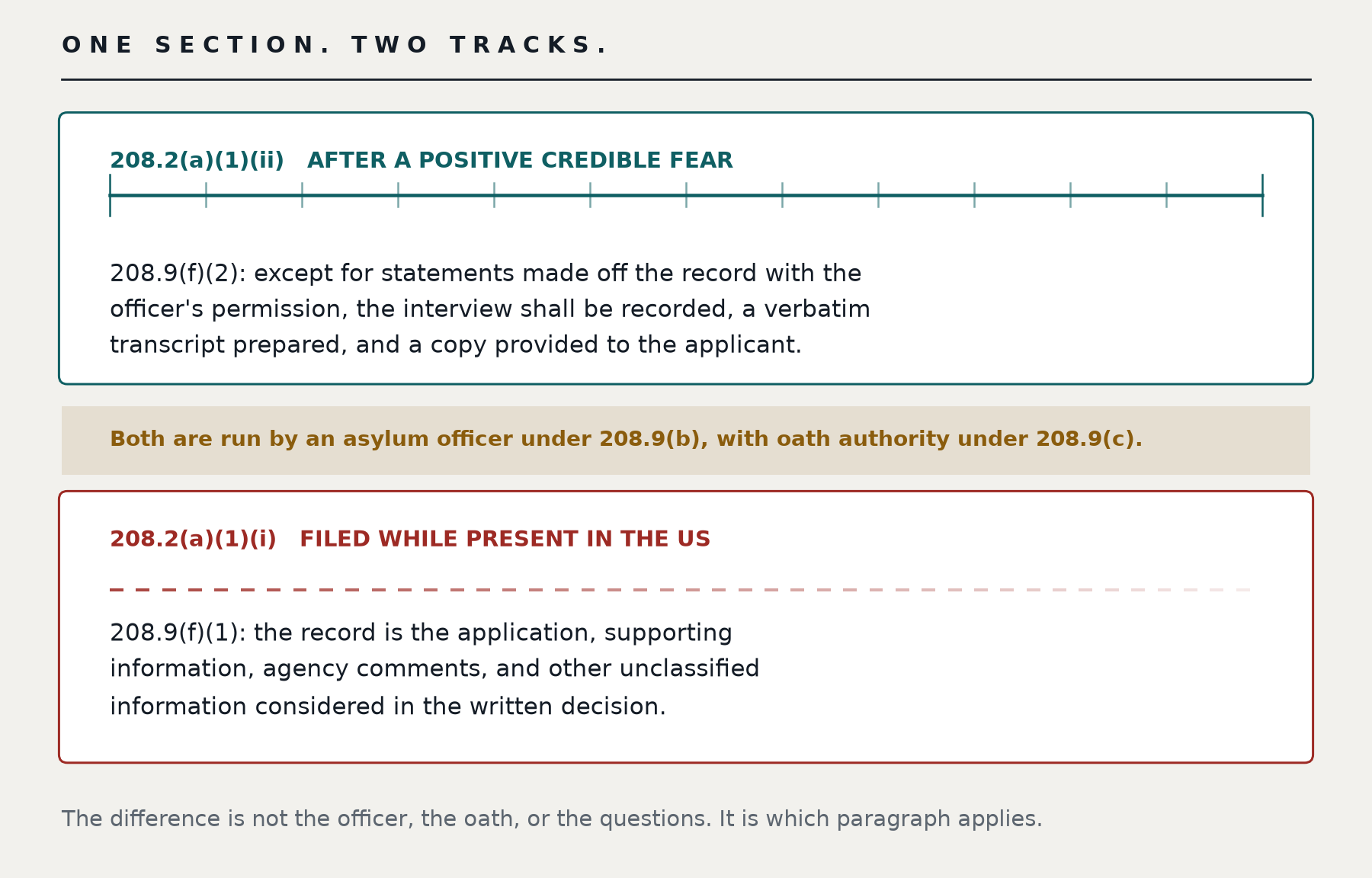
One Paragraph Apart, Two Completely Different Records
Read the very next paragraph. For interviews under 208.2(a)(1)(ii), the ones held after a positive credible fear determination, 208.9(f)(2) says that except for statements made off the record with the officer’s permission, the interview shall be recorded. A verbatim transcript is prepared, included in the referral package to the immigration judge, and a copy is provided to the applicant.
Note how complete that provision is. It does not merely permit recording. It requires it, names the output as verbatim, routes the transcript into the file that follows the case, and puts a copy in the applicant’s hands. Someone drafted a full chain of custody for the spoken word and it sits immediately below the paragraph that requires none of it.
Same officer. Same oath authority. Same nonadversarial format. Same purpose.
The only thing that changed is which paragraph of 208.2(a)(1) the case arrived under. File affirmatively while physically present in the United States, and you land in 208.9(f)(1), where the record is a list of documents and the interview leaves no transcript at all. Arrive through the credible fear route instead, and the identical conversation is captured word for word.
An applicant does not choose which paragraph they enter under. That is determined by the path the case took to reach the interview room, often years before anyone thought about evidence. Whether the most consequential conversation of the process survives as words is decided by a jurisdictional accident.
Why the Usual Fixes Do Not Hold
The intuitive responses each fail for a different reason, and it is worth being precise about why, because each one is the fix a reasonable person reaches for first.
- The officer’s notes belong to the officer. They are written to support a written decision, not to preserve the exchange. They are a work product with an author and a purpose, and neither is the applicant’s.
- The closing statement is discretionary. Under 208.9(d)(1) the applicant or representative may comment on the evidence, but the officer may limit its length or require it in writing. The one clearly authorized opportunity to put your own framing on the record is available at the officer’s discretion, in a format the officer may choose.
- Referral does not reset the record. Under 208.14(c)(1) a case that is not granted goes to an immigration judge, where the earlier account is compared against new testimony. The first telling does not disappear because it was never transcribed; it persists as whatever the officer wrote about it.
- Paraphrase cannot rebut paraphrase. Handwritten notes capture the gist and lose the wording, and wording is what gets challenged. Being confident about what you meant is not evidence of what you said.
This matters because 8 USC 1158(b)(1)(B)(iii) lets a credibility determination rest on the consistency between an applicant’s written and oral statements, whenever made and whether or not under oath, and expressly without regard to whether an inconsistency goes to the heart of the claim.
Follow that clause to its conclusion. Every sentence spoken in that room is potential impeachment material, at any later stage, on any subject, however peripheral. The statute makes the spoken word an exhibit. The regulation declines to preserve it. The applicant carries the consequences of a discrepancy between two accounts while holding a verifiable copy of neither.
What Actually Works
Start with the constraint, because pretending it is not there produces bad advice. USCIS controls the interview room, and the applicant does not record what happens inside it. Nothing here is a suggestion to change that.
What an applicant and representative do control is everything on either side of that hour. That is where a usable record gets built, and it is more valuable than it first appears: a contemporaneous account made before the interview and a detailed debrief made immediately after will bracket the testimony closely enough to be worth something months later, when an alleged discrepancy surfaces and nobody can remember the wording.
Two habits carry the weight. Capture the prepared account in full before the interview, in the applicant’s own language. Then debrief immediately afterward, question by question, while recall is intact. The debrief is the one that gets skipped, and it is the one that matters most — it is the only artifact anywhere in the process that attempts to record what was actually asked and answered.
AmyNote is built for exactly that kind of spoken record. Transcription runs on OpenAI’s latest Speech API, which holds up on the names, dates, places and country conditions vocabulary that generic tools mangle. Speaker identification with cross-session memory keeps the applicant, the interpreter and the representative separated across every session. AI analysis runs on Anthropic’s Claude Opus, so when a discrepancy is alleged months later, semantic search finds what the applicant actually said in March instead of a legal pad.
On privacy, AmyNote states plainly that it does not use customer data to train AI models and does not sell content. Audio and text are encrypted in transit with TLS. The saved library of recordings, transcripts and notes lives on the representative’s iPhone or iPad, and playback, reading and export work with no network at all. The company is equally explicit about the limit: local-first is not local-only, and a processing copy may be retained when transcription or an AI summary runs. For work this sensitive, a vendor that writes its own caveat down is worth more than one that leaves it to be discovered.
Getting Started
Record the preparation sessions and the debrief, not the interview. Transcription is by OpenAI, AI analysis is by Anthropic’s Claude Opus, and both providers are contractually barred from training on user data. AmyNote supports over 120 languages with real-time translation, which matters when the account that decides the case was never given in English. A three-day free trial needs no credit card.
The regulation is not going to change before the next interview. The record on either side of it is the part still within reach.
Originally published as an X Article by @AmyNoteApp.