The hearing runs twenty minutes and decides whether your client sleeps at home tonight or stays detained for another year. The judge names three reasons from the bench, sets the bond, and calls the next case.
Nothing that just happened is part of the record in the removal case, and nobody wrote it down.
That is not the result of a busy docket or an unusually terse judge. It is what the regulation provides for, and reading it in order makes the design visible.
The Removal Hearing Is Recorded Verbatim. Bond Is Carved Out of It.
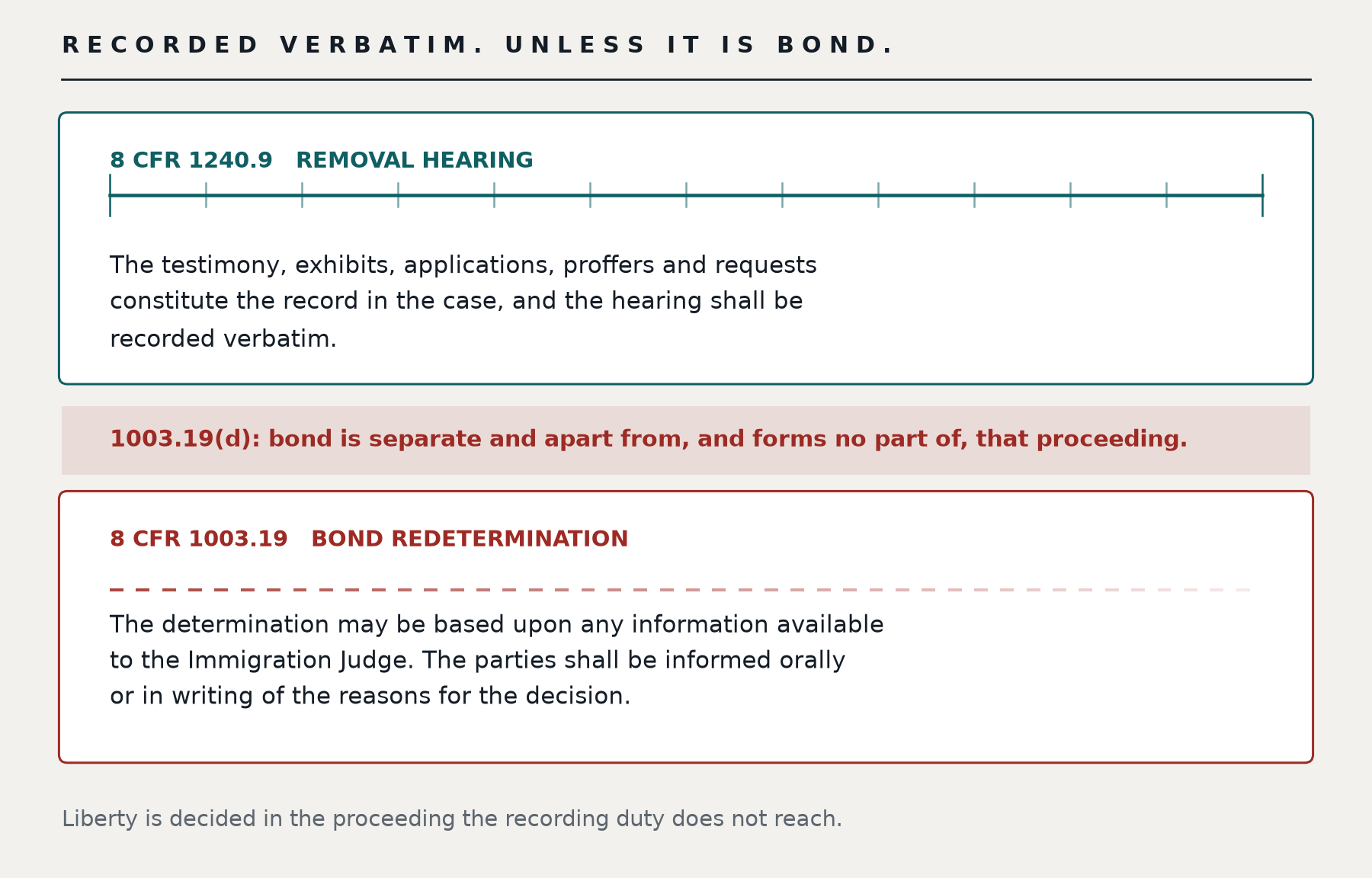
8 CFR 1240.9 is unambiguous about the merits hearing. The hearing before the immigration judge, including the testimony, exhibits, applications, proffers, and requests, constitutes the record in the case, and the hearing shall be recorded verbatim except for statements made off the record with the permission of the immigration judge.
Then 8 CFR 1003.19(d) lifts bond out of that sentence. Consideration by the Immigration Judge of an application or request of a respondent regarding custody or bond shall be separate and apart from, and shall form no part of, any deportation or removal hearing or proceeding.
The verbatim recording duty attaches to the proceeding about whether your client stays in the country. The proceeding about whether they spend that year detained sits outside it. Read 1003.19 start to finish and count the words it spends on transcripts, recordings, or a written decision. There are none.
It is worth being precise about what that does and does not mean. Nothing here is misconduct, and nothing suggests immigration judges are withholding anything. A bond hearing conducted with no recording and reasons delivered aloud is fully compliant. The regulation simply pairs a decision of enormous consequence with no preservation obligation at all, so the fullest account of what was said exists only as memory unless someone on your side decided in advance to keep one.
The Judge May Rely on Anything, and May Explain It Out Loud
The same paragraph sets the evidentiary floor at the ground. The determination of the Immigration Judge as to custody status or bond may be based upon any information that is available to the Immigration Judge or that is presented to him or her by the alien or the Service.
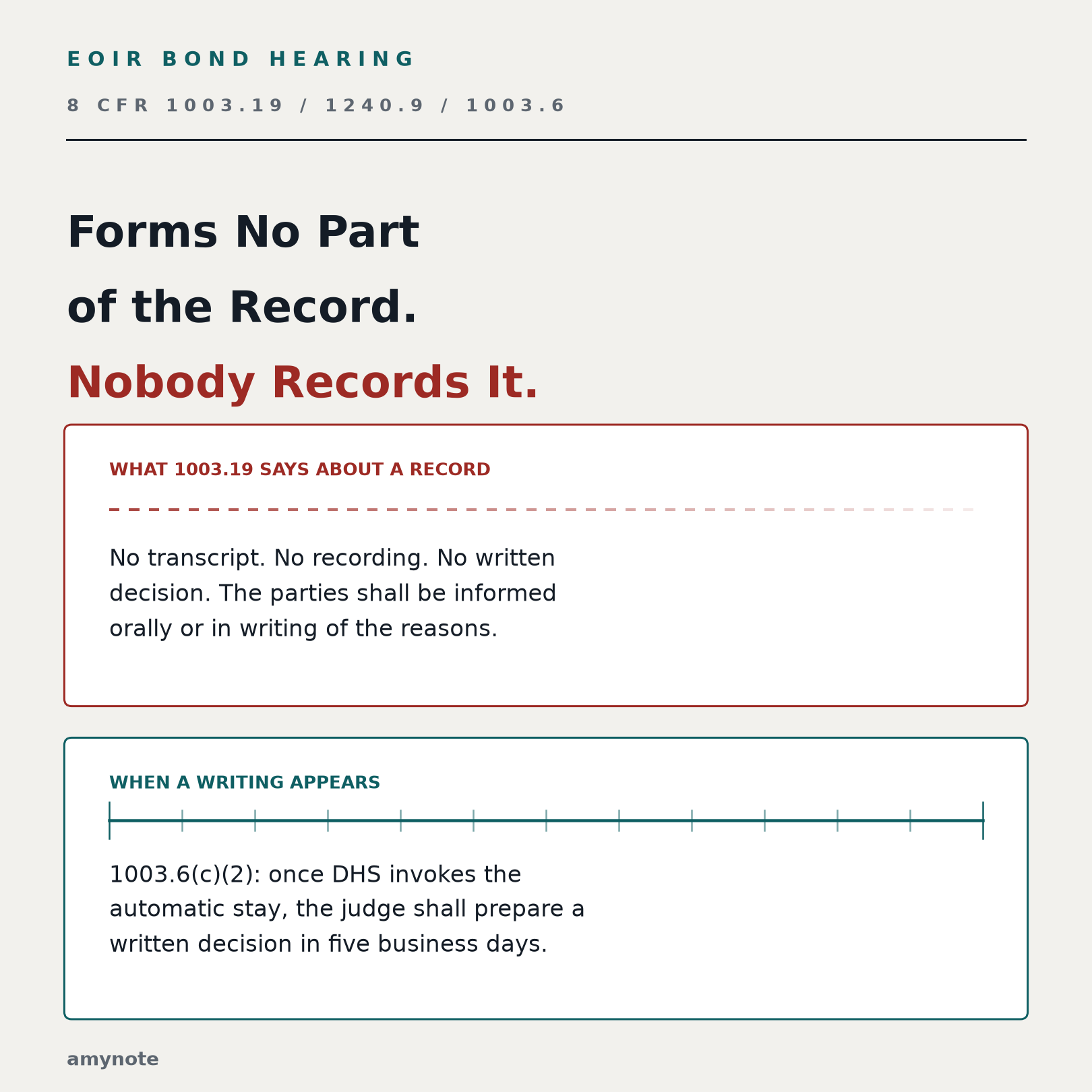
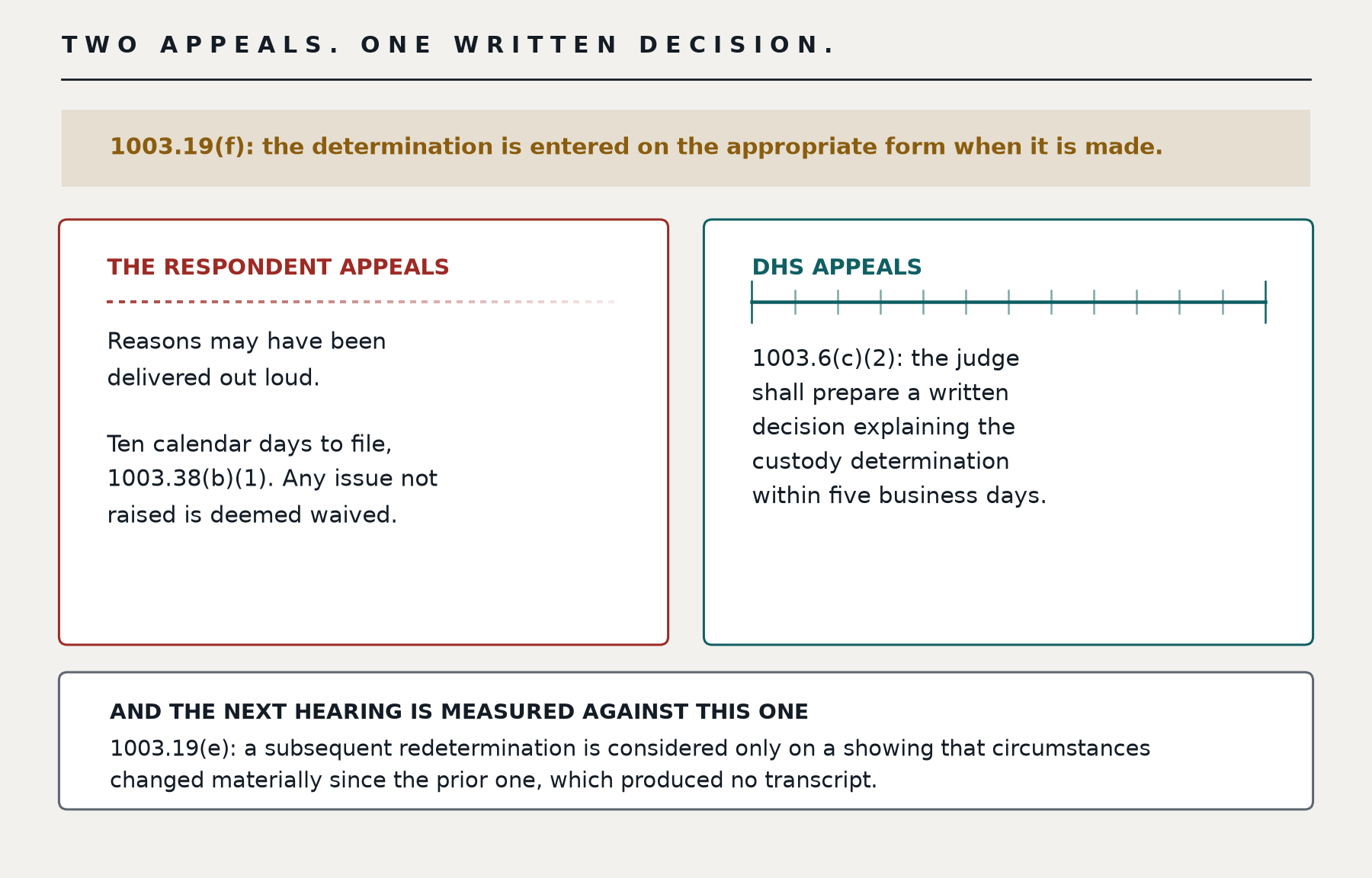
Under 8 CFR 1003.19(f), the determination is entered on the appropriate form at the time it is made, and the parties shall be informed orally or in writing of the reasons for the decision. Orally satisfies the rule. A judge can deliver the entire reasoning from the bench, and the regulation stops asking.
Put those two provisions side by side and the practical problem comes into focus. The universe of material the judge may rely on is unbounded, and the obligation to memorialise which parts were actually relied on is nil. On appeal you are not arguing against a stated rationale in a document. You are reconstructing one.
The Asymmetry That Decides Cases
- When the government appeals, the writing requirement switches on. Under 8 CFR 1003.6(c)(2), once DHS invokes the automatic stay, the immigration judge shall prepare a written decision explaining the custody determination within five business days, and the immigration court shall prepare and submit the record of proceedings without delay. When the respondent appeals, 1003.19(f) still permits reasons given out loud.
- You get ten calendar days, and silence waives. 8 CFR 1003.38(b)(1) sets the Notice of Appeal deadline at ten calendar days, and the thirty day window in (b)(2) reaches only adjudicated asylum applications. The same section adds that any issue not raised in the Notice of Appeal shall be deemed waived.
- The second hearing is measured against the first. Under 8 CFR 1003.19(e), a subsequent bond redetermination is considered only on a showing that circumstances have changed materially since the prior bond redetermination. You are proving change against a hearing that produced no transcript.
Why the Usual Workarounds Fail
Waiting for the written decision. It arrives only when DHS invokes the automatic stay under 1003.6(c)(2). On a respondent’s appeal there is no equivalent trigger, so the document that would have framed your argument is produced only in the posture where the government, not you, chose to appeal.
Relying on the form. Under 1003.19(f) the determination is entered on the appropriate form at the time it is made. A form records the outcome. It is not a record of the reasoning that produced it, and the reasoning is what a Notice of Appeal has to engage.
Planning to develop the issue later. 1003.38(b)(1) forecloses that directly: any issue not raised in the Notice of Appeal is deemed waived. The ten calendar day window is the entire opportunity to identify what to challenge, and it runs on whatever account of the hearing exists at the time.
Assuming the next hearing is a fresh start. It is not. Under 1003.19(e) the second bond request is judged against the first, so the untranscribed hearing does not stop mattering when it ends. It becomes the baseline every later request is measured against, months after anyone can quote it.
What Actually Works
Start with what you cannot do. Immigration courts do not permit parties to record proceedings, and no tool changes that. The recording that matters is the one you make in the hallway ninety seconds after the judge rules, while you can still quote the reasons in order.
Memory does not degrade evenly, which is why the timing matters more than the effort. What survives a month is the gist — the judge was worried about flight risk. What disappears first is exactly the detail an appeal turns on: which fact, characterised how, in response to which argument, and in what order.
That is the discipline AmyNote is built for. It runs on the phone already in your pocket and transcribes with OpenAI’s Speech API, which holds up on the vocabulary these cases turn on: bond redetermination, danger to the community, flight risk, mandatory detention, changed circumstances. Speaker identification separates counsel, client, and family, so a detention facility call is attributable line by line.
Anthropic’s Claude Opus then turns each session into the artifacts the next filing needs: every reason the judge stated, the bond amount, the findings you intend to challenge, and the ten day clock under 1003.38(b)(1) counted from the date of the decision. Semantic search across sessions is what builds the 1003.19(e) showing, because materially changed circumstances only exist if you can retrieve what the circumstances were in March.
Immigration practices ask about privacy first. Both OpenAI and Anthropic contractually guarantee zero training on user data. Audio is encrypted in transit and not retained after processing. Transcripts are stored locally on device with end-to-end encryption.
Getting Started
Decide who owns the bond record before the next hearing, because the regulation assigns it to no one on your side. Build the post-hearing readout into the case checklist the way the ten day calendar entry already is, and do it while nothing is pending — it takes an afternoon in a quiet week and is impossible to invent in the corridor after an adverse ruling.
AmyNote runs on the phone you already carry, transcription by OpenAI, analysis by Anthropic Claude Opus, transcripts encrypted on device, zero training on your data. Walk out of the courtroom with the stated reasons and the ten day deadline written down, not remembered. AmyNote runs on the phone already in your pocket.
Originally published as an X Article by @AmyNoteApp.