The call comes at 9:40 on a Tuesday and runs eighteen minutes. By the end of it the higher-level adjudicator has agreed the March examination was inadequate and that the 2019 decision misread two lines of the service treatment records.
Nothing about that call was recorded. The evidence window closed months ago. And the veteran does not get another one.
One Conference, and the Rule Preserves Nothing
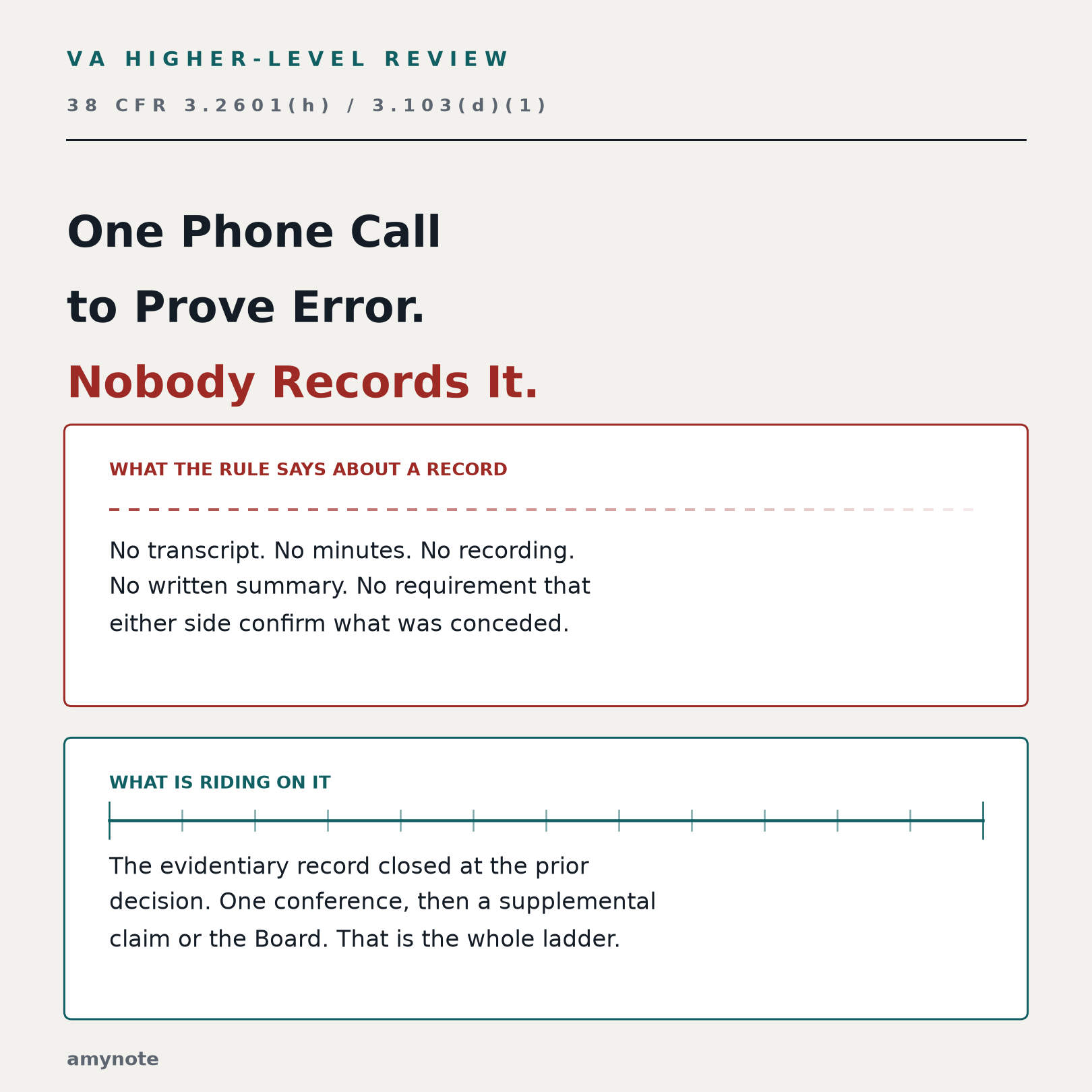
38 CFR 3.2601(h) lets a claimant or representative request an informal conference with a higher-level review. The rule defines it narrowly: contact, telephonically or as otherwise determined by VA, for the sole purpose of allowing the claimant or representative to identify any errors of law or fact in the prior decision based on the record at the time that decision was issued.
VA will make reasonable efforts to conduct one informal conference. If those efforts are not successful, the rule says a decision may be issued in the absence of an informal conference. Any expenses the claimant incurs are the claimant’s.
Now count the words 3.2601 spends on documentation. There are none. No transcript, no minutes, no recording, no written summary, no requirement that either side confirm what was conceded. The higher-level adjudicator with determinative authority over the issue conducts the call personally, and the rule asks no one to write down a word of it.
That is worth sitting with, because it is easy to misread as an oversight. It is not. The informal conference is deliberately informal — the point is to let a claimant flag error quickly without the machinery of a hearing. The cost of that design choice is that the single proceeding where the decision-maker engages directly with your argument produces no artifact at all.
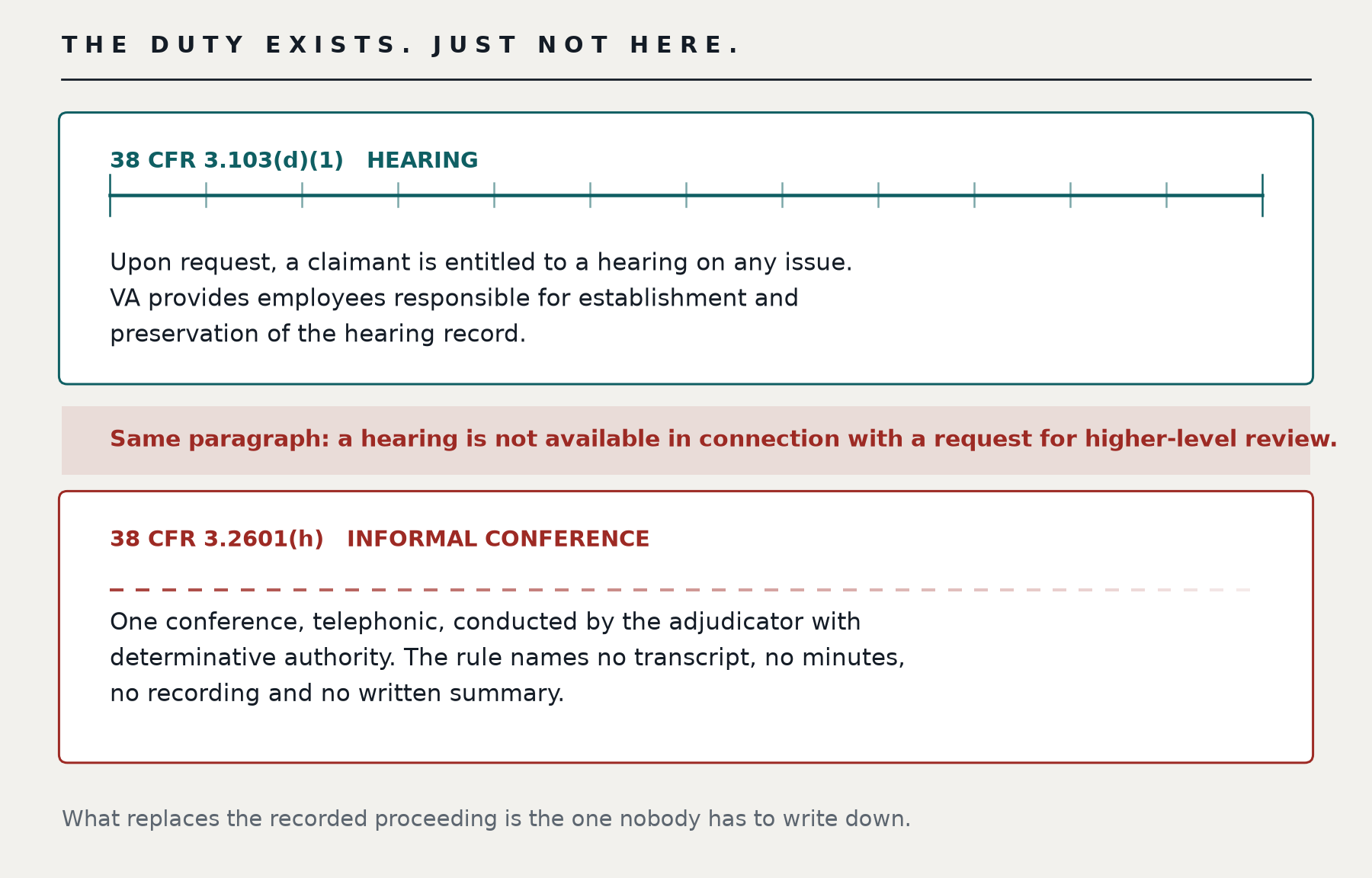
The Same Part Requires a Hearing Record. You Just Cannot Have a Hearing.
38 CFR 3.103(d)(1) gives claimants the right to a hearing on any issue, and it puts the duty in plain terms: VA provides employees with original determinative authority to conduct the hearing and to be responsible for establishment and preservation of the hearing record.
The same paragraph then closes the door. A hearing is not available in connection with a request for higher-level review under 3.2601.
So the proceeding that carries an explicit preservation duty is the one an HLR claimant cannot have. The informal conference replaces it, and nothing preserves that. The regulation does not assign the record to VA, and it does not assign it to the claimant either. It simply does not assign it.
Why Notes and Recall Fail Here
Contemporaneous notes are the usual answer to a proceeding nobody transcribes, and in this lane they are unusually weak. Three structural reasons why:
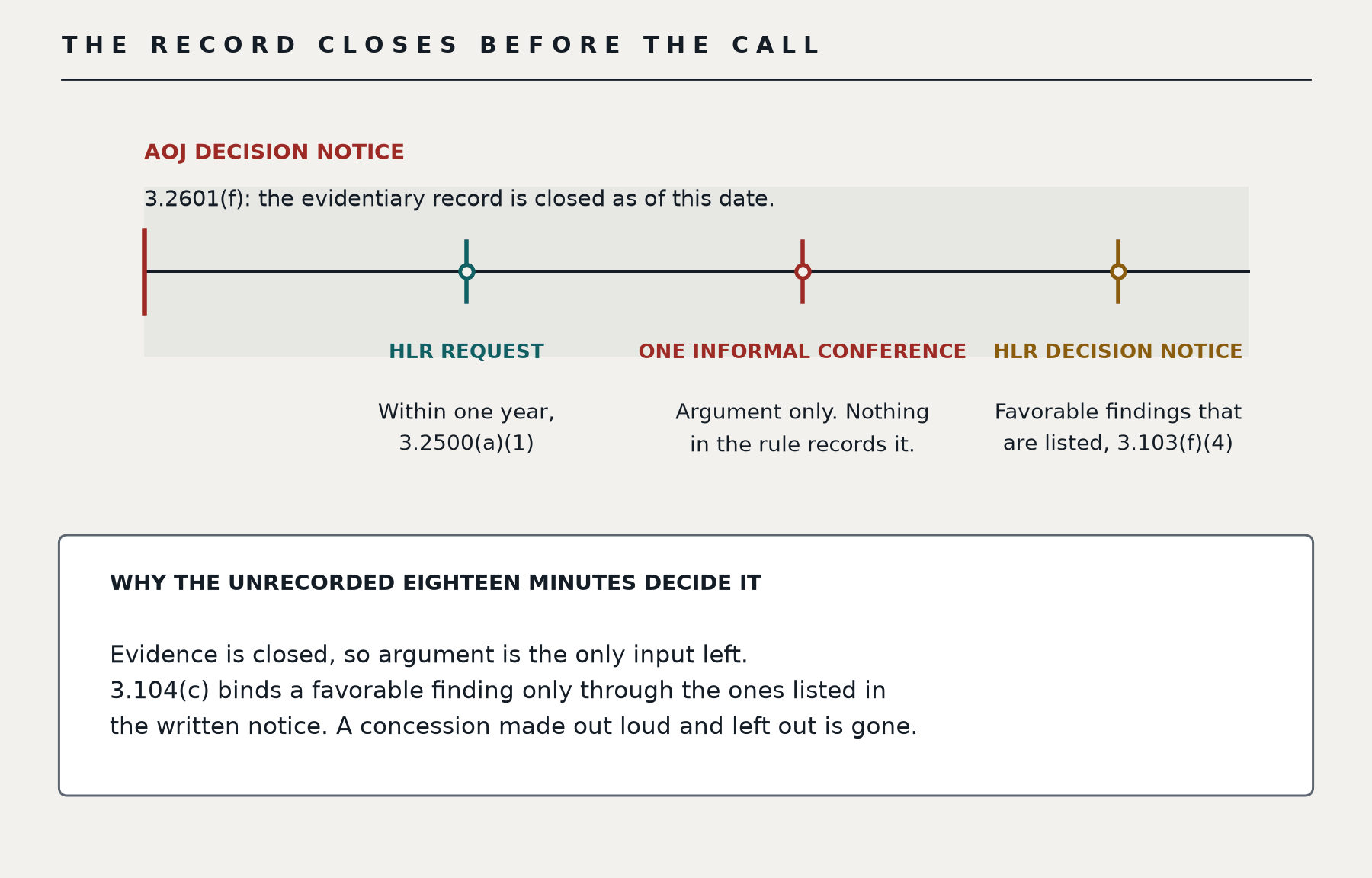
- The conference is the only thing left to add. Under 3.2601(f) the evidentiary record is closed as of the date VA issued notice of the decision under review, and the adjudicator may not consider additional evidence or order development, except to correct a duty to assist error under 3.2601(g). Argument is the entire contribution, and argument is what nobody captures.
- An oral concession that never reaches the letter is not a finding. 38 CFR 3.104(c) makes a favorable finding binding on every later agency and Board adjudicator unless rebutted by clear and unmistakable error. But it runs through findings described in 3.103(f)(4), the ones listed in the written decision notice. A concession made on the phone and omitted from the notice leaves nothing to point at.
- The next stop is built on what happened here. After an HLR decision, 38 CFR 3.2500(c)(2) leaves a supplemental claim or an appeal to the Board. Both are argued against a record that never included the eighteen minutes where the adjudicator named the error they accepted.
Put those together and the failure mode is specific rather than general. It is not that the veteran forgets the call. It is that the one sentence worth preserving — the adjudicator conceding a particular error, in their own words — is the sentence a handwritten note is least likely to capture verbatim, and verbatim is what makes it usable later.
What Actually Works
The fix is not a court reporter. It is a complete, searchable record of a proceeding the regulation leaves undocumented.
AmyNote records the conference on the phone that is already taking the call and transcribes it with OpenAI’s Speech API, which holds up on the vocabulary these cases turn on: duty to assist, clear and unmistakable error, favorable finding, effective date, diagnostic code. Speaker identification separates the adjudicator, the accredited representative, and the veteran, so the transcript shows who conceded what.
Anthropic’s Claude Opus then converts the call into the artifacts the next filing needs: every error of law or fact identified, every point the adjudicator accepted or rejected, every date discussed, and the one year deadline under 38 CFR 3.2500(a)(1) measured from the notice actually under review. Semantic search across sessions pulls the earlier conference on the same diagnostic code, which is where an effective date argument usually lives.
Veterans service organizations ask about privacy first. Both OpenAI and Anthropic contractually guarantee zero training on user data. Audio is encrypted in transit and not retained after processing. Transcripts are stored locally on device with end-to-end encryption.
Recording rules vary by state and a federal adjudicator may decline. Ask at the top of the call, and write down the answer.
What to Capture, Whatever You Use
The tool matters less than knowing what the record has to contain to be worth anything two filings from now. Four things:
- The errors as identified, in the words used. 3.2601(h) frames the whole conference around identifying errors of law or fact in the prior decision. A list of the errors you raised, phrased the way you raised them, is the spine of the record.
- What the adjudicator accepted, and what they did not. The asymmetry is the point. A rejected argument tells you what to build for a supplemental claim or the Board; an accepted one tells you what to check the decision notice for.
- Every date discussed. Effective date arguments live and die on which notice the clock ran from, and 3.2500(a)(1) sets a one year window from the notice under review.
- Whether the concession made it into the notice. This is the step people skip. Under 3.104(c) a favorable finding binds later adjudicators only through the findings described in 3.103(f)(4) — the ones listed in the written notice. When the HLR decision arrives, read it against your record of the call. If something conceded on the phone is missing from the letter, you now know that before the year runs, not after.
Getting Started
Before the next informal conference, decide who owns the record, because the regulation does not assign it to anyone. AmyNote runs on the phone in your pocket — transcription by OpenAI, analysis by Anthropic Claude Opus, transcripts encrypted on device, zero training on your data. Hang up with the concessions, the identified errors, and the filing deadline written down while the review is still open.
Originally published as an X Article by @AmyNoteApp.