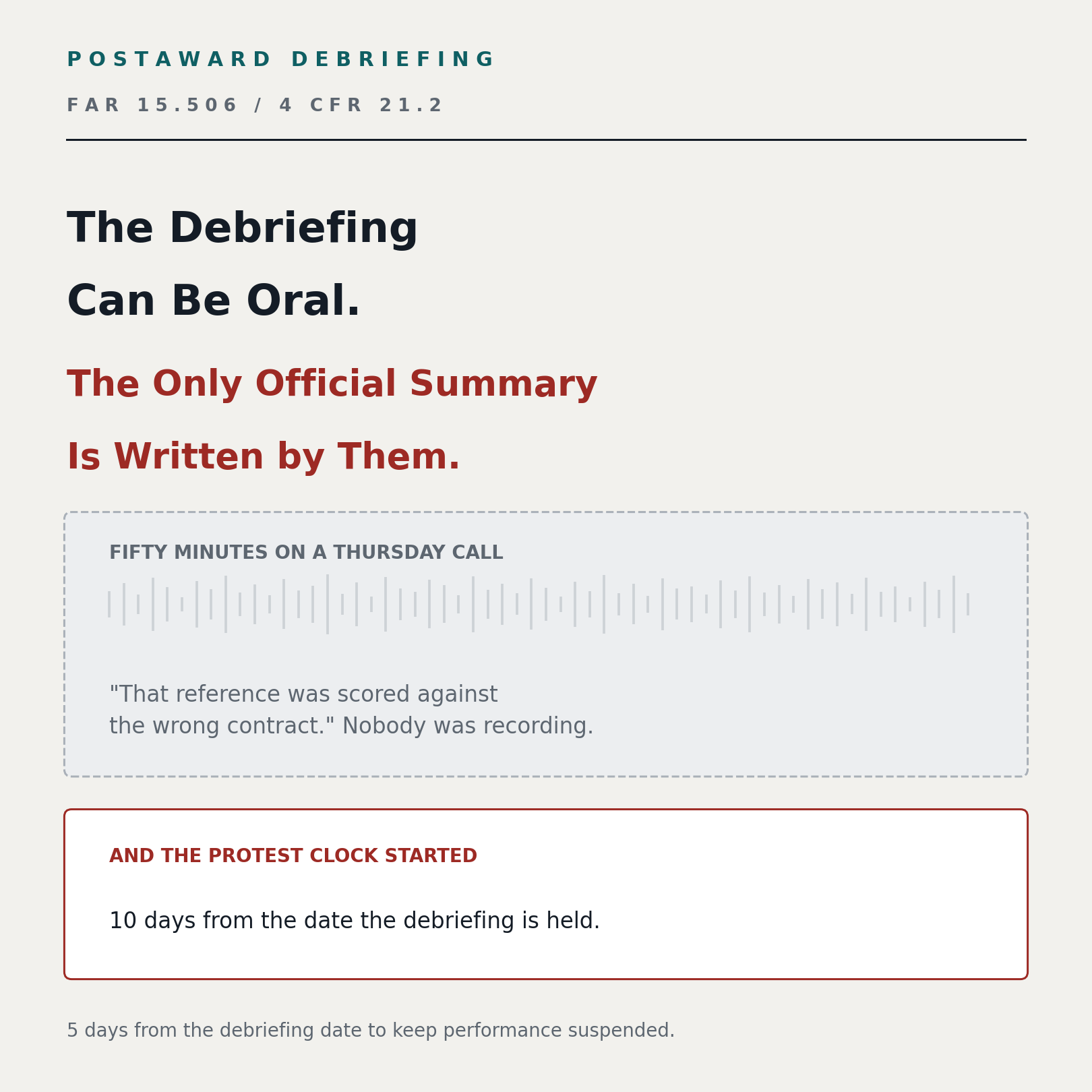
The debriefing is a fifty minute call on a Thursday. Four people from the capture team dial in, the contracting officer works through a deck that never gets sent, and at minute thirty one an evaluator says the past performance reference was scored against the wrong contract.
Nobody catches the exact wording, because the two people who would have taken notes were the two people asking questions. Ten days later you decide whether to protest.
That is not a story about a badly run capture team. It is the predictable result of how FAR 15.506 allocates the obligation to speak and the obligation to write.
The Rule Specifies the Content, Not the Medium
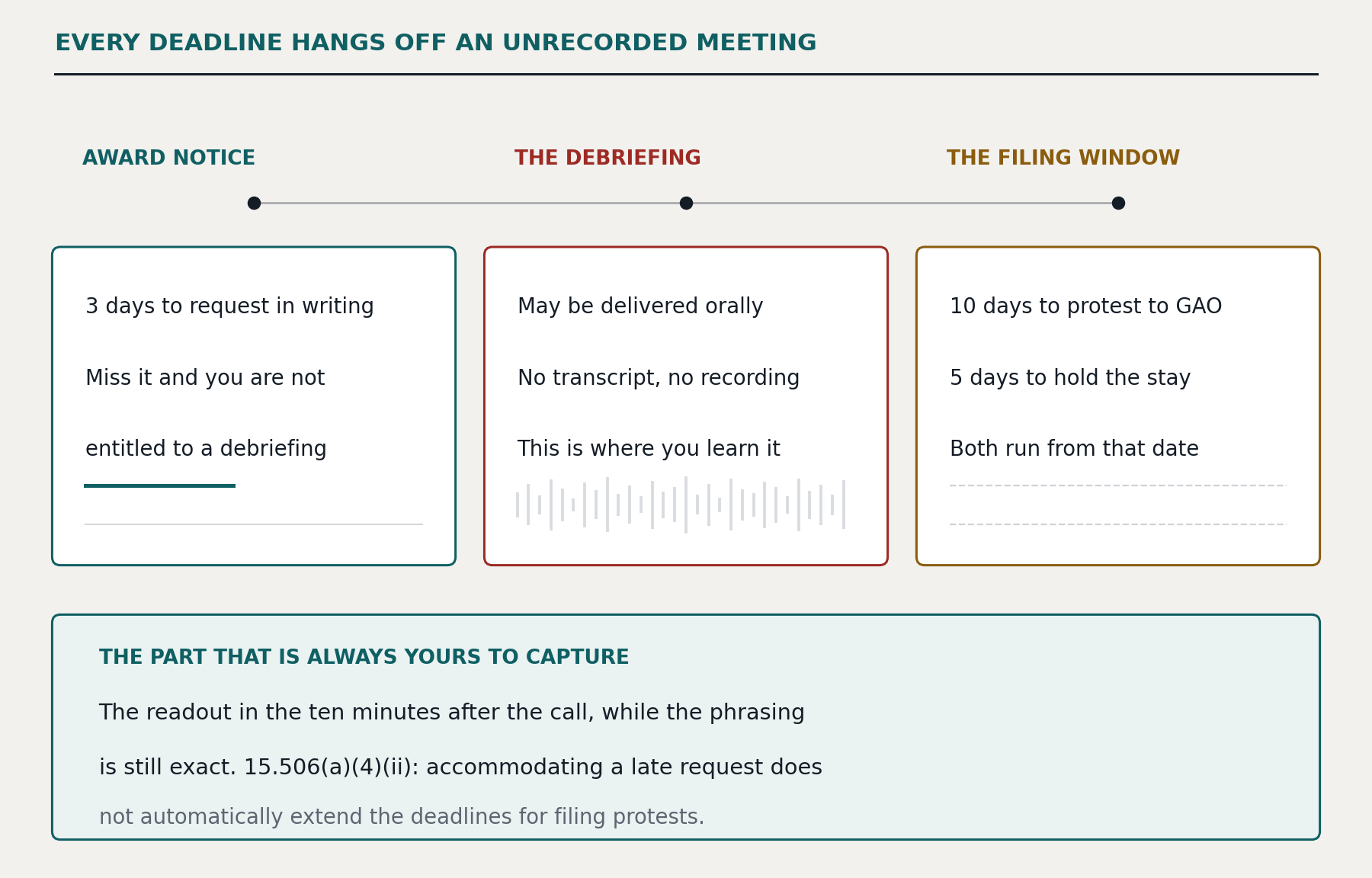
FAR 15.506(a)(1) is the entitlement. On a written request received within 3 days after notification of contract award, an offeror shall be debriefed and furnished the basis for the selection decision and contract award.
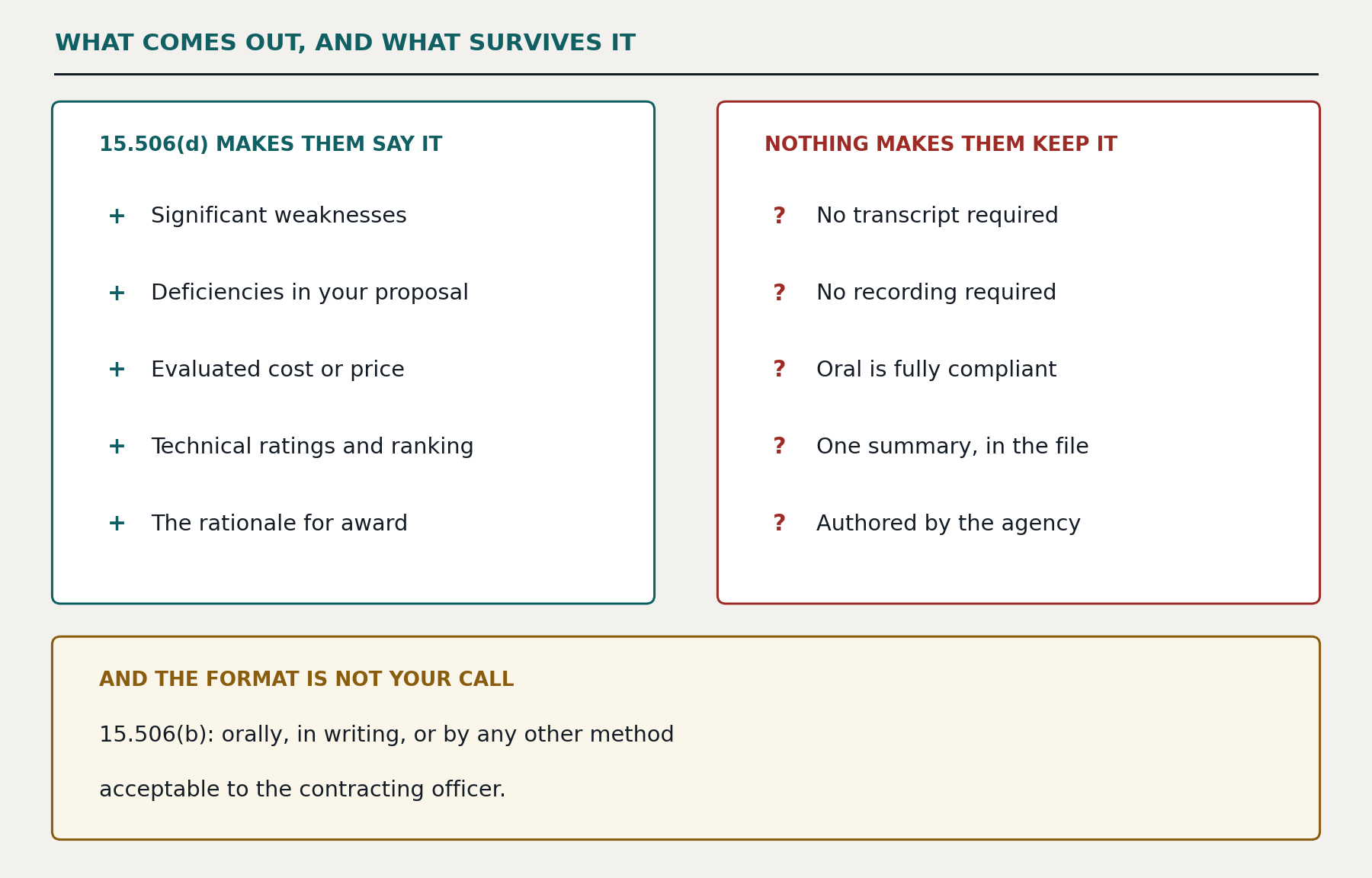
Section 15.506(d) is specific about what has to come out: the Government’s evaluation of the significant weaknesses or deficiencies in the offeror’s proposal, the overall evaluated cost or price and technical rating of the awardee and of you, the overall ranking of all offerors, a summary of the rationale for award, and reasonable responses to relevant questions about whether the stated procedures were followed.
Then 15.506(b) sets the format. Debriefings may be done orally, in writing, or by any other method acceptable to the contracting officer.
And 15.506(f) is the whole writing requirement: An official summary of the debriefing shall be included in the contract file.
Read those together. The disclosure is mandatory and detailed. The medium is the contracting officer’s choice. The only document the rule guarantees is a summary authored by the side that made the decision.
Nothing about that arrangement is adversarial, and it is worth saying so plainly. A contracting officer who holds an oral debriefing and files a summary has complied with the regulation exactly. But whoever writes that summary is compressing fifty minutes of question and answer into a file document, and every compression is a judgment about what mattered. When the drafter is the agency, the judgment is theirs, and your recollection of the call is not a competing record. It is not a record at all.
That Conversation Starts the Clock
Under 4 CFR 21.2(a)(2), where a debriefing is requested and required, the protest shall not be filed before the debriefing date offered to the protester, but shall be filed not later than 10 days after the date on which the debriefing is held.
The automatic stay runs tighter. FAR 33.104(c)(1) requires the contracting officer to suspend performance or terminate the award only when GAO notice arrives within 10 days after contract award or within 5 days after a debriefing date offered to the protester, whichever is later. Miss that and you may win a protest against a contract already half performed.
Asking for more time does not move either date. Under 15.506(a)(4)(ii), accommodation of an untimely debriefing request does not automatically extend the deadlines for filing protests.
The consequence is a timing problem rather than a legal one. The event that supplies the grounds for a protest is the same event that starts the clock for filing it, and that event is permitted to leave no artifact behind. Every downstream decision — protest or not, on which ground, with the stay or without it — is made from whatever account of the call your team happens to have.
Why the Usual Workarounds Fail
- Assuming it arrives in writing. DoD had to legislate around this. DFARS 215.506(b) makes a written or oral debriefing mandatory on request at 15 million dollars and up, 215.506(d)(ii) adds the redacted source selection decision document above 150 million, and 215.506-70 keeps the debriefing open until the agency answers written follow ups. Civilian agencies owe none of it.
- Relying on the official summary. It goes in the contract file under 15.506(f). You typically see it in the agency report, weeks after the decision to protest was already due.
- Splitting note taking across the team. Your sharpest listeners are your questioners. Notes thin out at the exact moment an evaluator concedes something.
- Planning to sort it out in the record. The GAO record follows the filing. The 10 day judgment gets made on memory.
The DFARS point deserves emphasis, because it is the strongest available evidence that this gap is real rather than theoretical. Enhanced debriefing rules exist because the baseline was not producing enough of a record on large defense awards. If the FAR 15.506 default were adequate, there would have been nothing to enhance — and outside DoD, the default is all there is.
What Actually Works
Put the format question in the request itself. The same letter that triggers 15.506(a)(1) can ask for the debriefing in writing and ask whether the session may be recorded. Contracting officers agree more often than capture teams assume, and a documented no is useful too — a written request that went unanswered is itself a dated document, which is a materially better position than a silence nobody can place in time.
Then capture your own side regardless. Hold the readout in the ten minutes after the call ends, while the phrasing is still exact, and record that instead of reconstructing it on day nine. Nobody needs permission to keep an accurate account of a conversation their own team just had, and this is the one part of the process that is never at the contracting officer’s discretion.
AmyNote captures it on the phone already on the table. Transcription runs on OpenAI’s latest Speech API, which handles the vocabulary that breaks consumer tools: significant weakness versus deficiency, technical acceptability, price realism, best value tradeoff, source selection authority, corrective action.
Analysis runs on Anthropic’s Claude Opus, so you can ask the transcript what the evaluator actually said about the past performance reference rather than replaying an hour of audio the night before a deadline. Speaker identification separates capture lead, proposal manager, and counsel, and cross session memory carries from the debriefing readout into the protest decision meeting.
On privacy: both OpenAI and Anthropic contractually guarantee zero training on user data. Audio is encrypted in transit and not retained after processing. Transcripts stay local on the device with end to end encryption. No proposal strategy and no source selection detail sitting on a third party server.
Getting Started
Write the debriefing request template this week, before an award notice starts a 3 day clock. Build the recording question and the written debriefing request into it, so the format decision is made once rather than improvised under a deadline.
Then block fifteen minutes after every debriefing for a recorded readout, and make the protest call from a transcript instead of four sets of partial notes. The regulation gives the agency the pen on the only guaranteed document. The part it cannot take away is the account you were always free to keep yourself. AmyNote runs on the phone already in your pocket.
Originally published as an X Article by @AmyNoteApp.