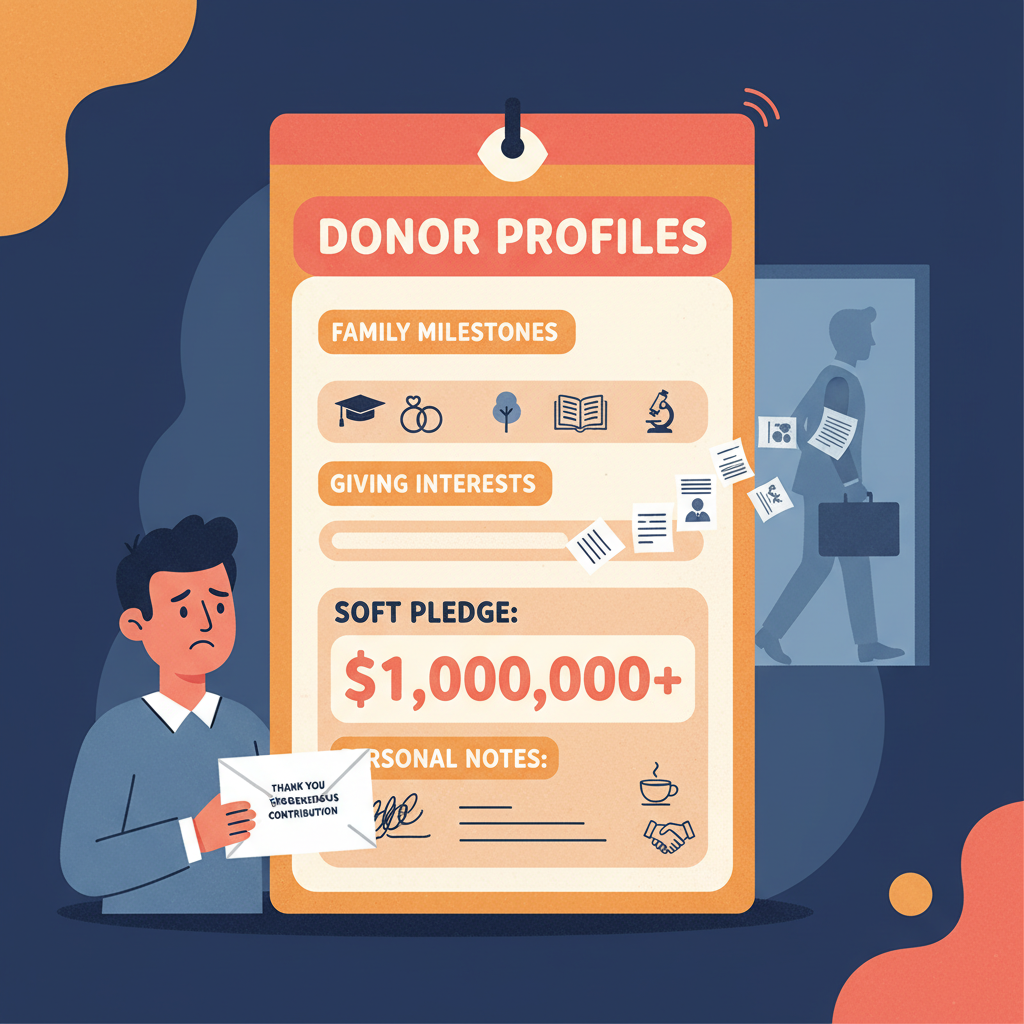
A major gift officer meets a longtime donor for lunch. Over ninety minutes they cover the donor's daughter's wedding, a recent health scare, a trip to Kyoto, skepticism about the current capital campaign, and a half-hint that a planned gift from the family foundation "could grow" after the next board meeting. Back at the office, the officer logs six bullet points into Raiser's Edge and flags a follow-up. Eight months later she takes a role at another institution. Her replacement pulls up the donor record, sees six bullet points, and walks into the next meeting cold. The donor notices within two minutes.
Major gift teams are built on relationships that depend on memory. Turnover in fundraising runs north of 20% a year, and every exit takes years of donor context with it. The institution keeps the CRM. The knowledge leaves in the moving boxes.
This is the donor memory problem, and it is why seven and eight-figure relationships quietly stall when the person who knew them leaves. It is also quietly one of the most expensive sources of leakage in the nonprofit sector, because unlike a sales opportunity a donor relationship is not replaced by a new lead. There is one donor. One history. One lifetime of trust that was being built, one conversation at a time.
The Problem: Relationship Context Lives in One Person's Head
Major gift cultivation is not transactional. An officer builds a relationship over three to seven years before a transformational gift closes. Across that arc there are dozens of touchpoints: site visits, campus tours, dinners, board meetings, hospital bedside calls, condolence notes, quick hallway chats during an honoree dinner. Each one surfaces signals that never make it into a structured field: a spouse's passion for early-childhood education, frustration with the last president, a grandchild entering the donor's alma mater, a vague reference to a liquidity event next year.
CRMs like Blackbaud Raiser's Edge, Salesforce Nonprofit Cloud, and Bloomerang were designed for moves management, not memory. Officers log a few sentences after each visit, but the texture of the conversation, what the donor actually said, which cause they leaned forward on, which topics drew a cold response, which stories made them tear up, lives in the officer's notebook, in her head, or in a scratch doc buried inside her personal drive.
When that officer leaves, so does all of it. And across the sector, the average tenure of a major gift officer is under two years. In a seven-year cultivation cycle, that means a donor may be passed between three or four officers before the ask is ready, and each handoff loses more fidelity than the last.
Why Current Solutions Fail
- CRM notes are too short to be useful. A five-line recap cannot capture the tone, objections, and giving psychology that shape a seven-figure ask. It captures what was decided. It does not capture what was felt.
- Audio recordings, when they exist, are unsearchable. Nobody re-listens to a 90-minute lunch to prep the handoff meeting. Even if the recording is there, the time cost makes it effectively invisible.
- Generic meeting bots cannot attend most donor interactions. Cultivation happens at dining tables, on estate tours, on hospital visits, in a donor's living room. No Zoom link. No bot. No transcript.
- Templated "stewardship plans" give the illusion of continuity without the actual relationship intelligence. Donors see through generic thank-yous immediately. They notice when the new officer does not know their spouse's name, or leads with the same program area that the donor explicitly walked away from two years ago.
- Peer briefings rarely happen before the exit. A departing officer is already mentally at the next institution. Handoff notes get written in a rush, or not at all.
What Actually Works
Modern AI transcription built for in-person, high-stakes conversations closes the gap. Not the bot that joins a video call, but a phone or laptop quietly capturing audio in the room, producing a searchable transcript and a structured summary within minutes of the meeting ending.
Institutional memory should outlive any single person's tenure. If the donor has been cultivated for seven years, the record of that cultivation should not end with one resignation letter.
AmyNote was built for exactly this. Audio is captured on the officer's device and transcribed through OpenAI's latest Speech API, which handles domain language (planned giving, charitable remainder trust, donor-advised fund, endowed chair, capital campaign pledge, naming opportunity, bequest intention) with the same accuracy it gives clinical or legal terminology. Speaker identification separates the officer, the donor, and a spouse or attorney joining the conversation, and remembers them across future meetings instead of resetting to "Speaker 1" every time.
Summaries are generated by Anthropic's Claude Opus into consistent sections a development team can actually use:
- Giving Interests. Which programs drew a leaning-forward response, which drew polite disinterest.
- Capacity Signals. References to liquidity events, business sales, inheritance, estate planning, major purchases.
- Family Context. Spouse, children, grandchildren, recent life events, ages, interests, health.
- Objections Raised. Concerns about the institution, skepticism about leadership, unresolved friction from past years.
- Commitments Made. Soft pledges, verbal intentions, timing signals, scheduled follow-ups.
- Next Steps. Who does what by when, including non-solicitation touchpoints.
The officer reviews, edits, and pastes the relevant parts into the CRM in minutes instead of letting context evaporate. That is the critical handoff moment: the CRM becomes a curated summary of the relationship, and the transcript archive becomes the long-memory layer behind it.
The Successor Handoff That Actually Works
When the officer eventually leaves, the successor inherits a searchable archive of every cultivation conversation, not a handful of bullet points. Semantic search surfaces every time a donor mentioned their grandson, every objection to the last campaign, every soft pledge signal, every mention of a specific program. The handoff meeting becomes a working meeting, not an awkward reintroduction.
A few practical patterns teams are using:
- Pre-meeting prep queries. "What has this donor said about our science program over the last five years?" returns every relevant excerpt, with timestamps and speaker attribution.
- Objection maps. Every hesitation, concern, or cold response is searchable, so the new officer does not accidentally re-open a wound the previous officer spent two years healing.
- Life-event timelines. Births, graduations, deaths, illnesses, anniversaries, career transitions. The new officer walks in knowing the personal shape of the donor's life, not just the giving history.
- Language matching. The successor learns how the donor actually talks about philanthropy, in their own words, not in the generic stewardship vocabulary of the department.
Privacy Is Non-Negotiable for Donor Data
Fundraising data is among the most sensitive material a nonprofit holds. Wealth information, estate details, health references, family dynamics, political leanings, personal losses. Any memory layer that captures this material has to treat it accordingly.
Both OpenAI and Anthropic contractually guarantee zero training on user data. Audio is encrypted in transit; processing copies may be retained to deliver and recover requested features. Transcripts are stored locally on the officer's device with encrypted transport, so confidential donor conversations never sit on a third-party server. That is the posture development teams need before anything else is worth discussing, and it is the posture generic meeting-bot vendors cannot match.
Getting Started
AmyNote offers a free trial with no credit card required. Major gift officers, planned giving staff, annual fund teams, capital campaign counsel, and donor-advised fund relationship managers can capture cultivation meetings, stewardship calls, and site visits and walk away with a searchable archive that outlives any single person's tenure. Institutional memory stops walking out the door with the next resignation letter.
If your department is heading into a capital campaign, a leadership transition, or a quiet year of stewardship, this is the moment to rebuild the memory layer before more context evaporates.
Originally published as an X Article.