You want every meeting captured, summarized, searchable. The question is where the audio comes from. A bot named Fred sitting in the Zoom call. A small black recorder you press before a coffee meeting. A phone in your pocket that listens. Same outcome, three very different paths — and the difference shows up in your wallet, your compliance review, and which conversations you can actually capture.
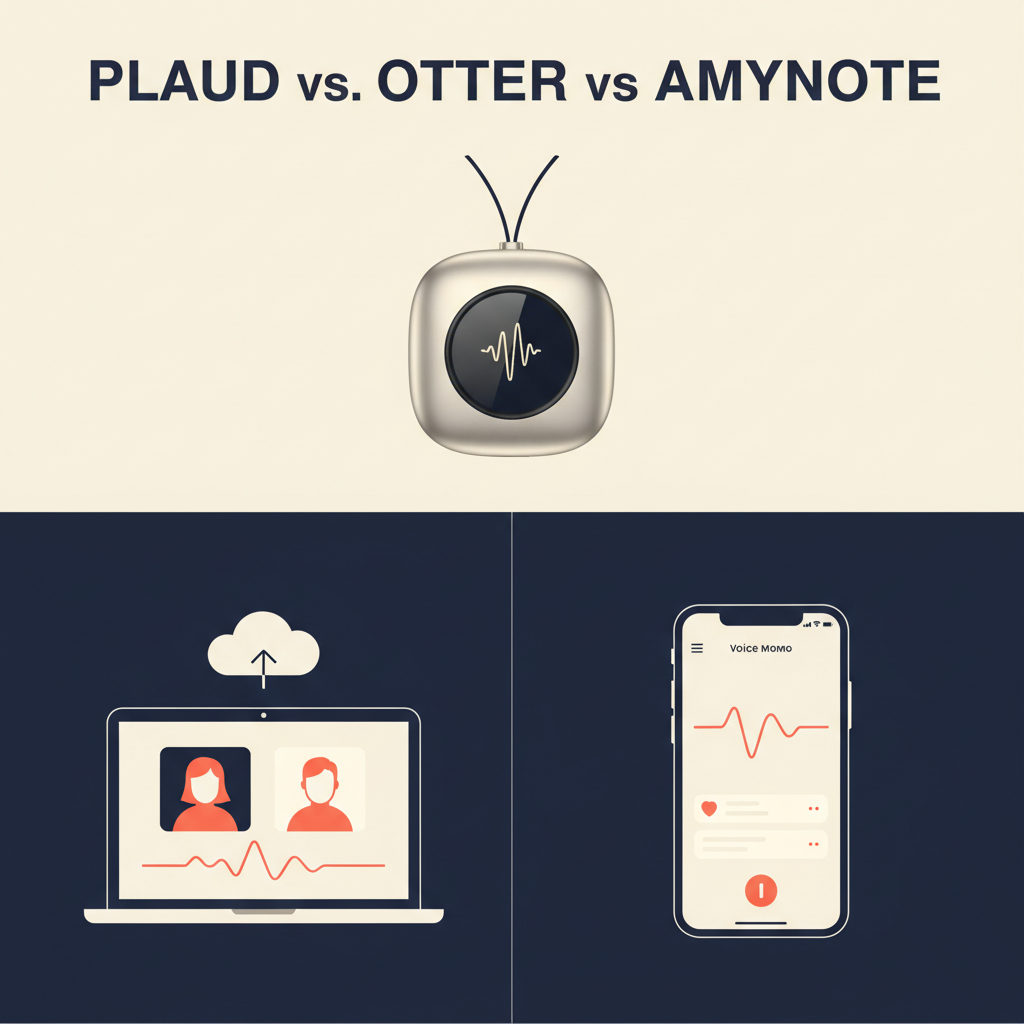
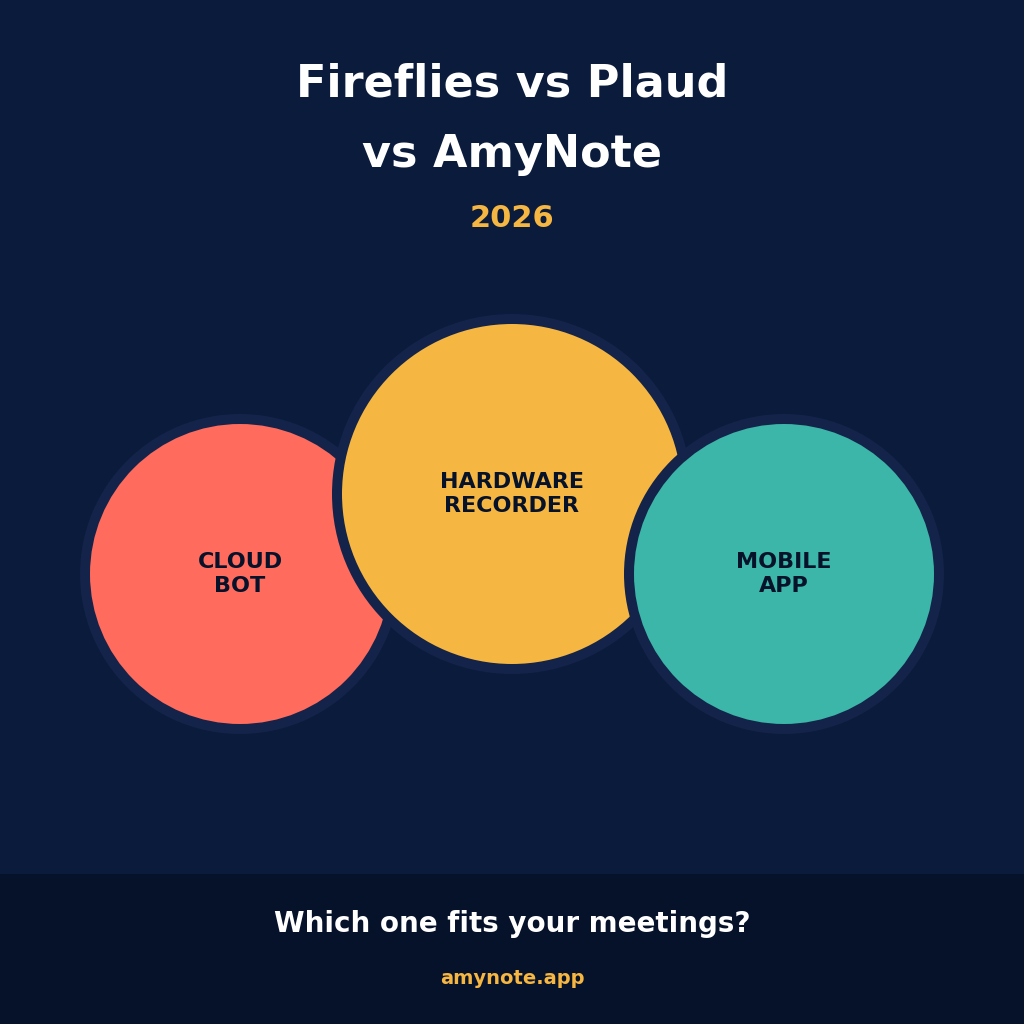
Three tools own those paths in 2026. Fireflies is the cloud powerhouse, with a bot in every meeting and an ecosystem map of CRM integrations. Plaud Note Pro is the hardware option, a physical recorder paired with a cloud app for AI summaries and mind maps. AmyNote is the mobile-first option, built for the conversations that never happen on a calendar invite.
The temptation is to treat them as interchangeable AI note-takers. They are not. The form factor decides which meetings get captured at all, and that is the most important spec in the category. The rest of this comparison walks through each tool, then ends with a side-by-side that maps each one to the rooms it was built for.
Quick Verdict
Pick Fireflies if 90 percent of your meetings are on Zoom, Meet, or Teams and you want every one flowing into Salesforce or HubSpot tomorrow.
Pick Plaud Note Pro if the conversations that matter most happen off-camera and you want a dedicated device that captures them at the boardroom, the client lunch, or the investor pitch.
Pick AmyNote if you do not want to carry an extra device, do not want a bot announcing itself, and want the phone already in your pocket to do the work.
What We Compared
Three things matter when the question is “how does the audio actually get in”:
- The capture device. A bot joining the call, a physical recorder, or the phone you already own.
- The privacy posture. Where audio travels and what the AI vendor is allowed to do with it.
- The total cost. Subscription, hardware, and the hidden caps past the headline price.
Pricing and features verified directly from each vendor as of June 2026. We treat the headline subscription number as the floor, not the ceiling — what matters is the price after the first overage.
Fireflies: The Cloud Bot Powerhouse
Fireflies has been the default in many sales orgs for years. A bot called Fred joins every scheduled call, captures the transcript, writes the summary. AskFred answers natural-language questions across every meeting you have had. It is the closest thing the category has to a memory layer for an entire revenue team.
Strengths
The integration story is the headline: Salesforce, HubSpot, Slack, Notion, Asana, Zapier, plus a Chrome extension for bot-free capture. Multi-language detection is strong, with 100-plus languages and word-level switching inside the same sentence. Accuracy lands around 95 percent on clean audio. New in 2026: Live Assist for real-time coaching and a desktop app that captures in-person audio without a calendar invite.
For a sales org that already runs on HubSpot or Salesforce, the value compounds. Every call ends up as a structured Opportunity update, action items pre-routed to owners, and conversation intelligence that surfaces patterns across hundreds of deals. The longer your team uses it, the more useful the search across past meetings becomes.
Weaknesses
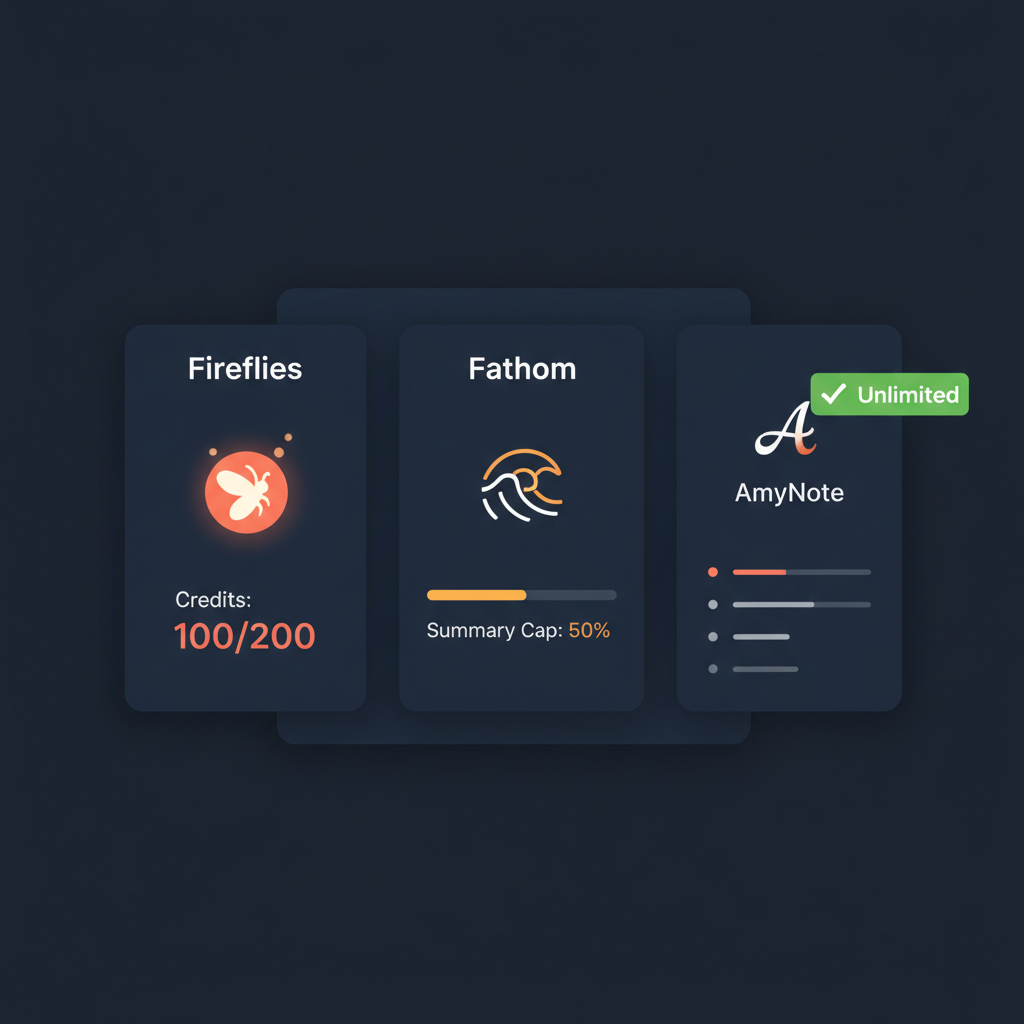
Fred appears as a participant in every call, which is exactly what executive escalations and churn risk discussions do not want. The AI credits system on paid plans is the hidden cost. Pro gets only 800 minutes of storage and 20 AI credits per month; heavy summary or AskFred use pushes teams into add-on credit bundles that auto-renew. Conversation intelligence still feels built for sales managers more than individual contributors.
The cumulative bill is the surprise teams hit at month three. The seat price is reasonable. The credit overage is not. Audit the storage minutes and AskFred usage in the first 30 days, or budget for the add-ons.
Pricing (current). Free with limited features. Pro $10 per user per month annual or $18 monthly. Business $19 annual or $29 monthly. Enterprise $39 annual.
Plaud Note Pro: The Hardware Recorder
Plaud took a different bet. Instead of fighting for a seat in the Zoom call, it sells a credit-card-sized device that captures audio in any room. Press the button, the recording starts. Sync to your phone after the meeting and the cloud app handles transcription and summary.
Strengths
Dual-mode capture for phone call vibration and ambient room audio, 64 hours of on-device storage, battery that lasts an investor day. Transcription supports 112 languages with speaker labels and custom vocabulary. The AI summary library is the deepest in the category: 10,000-plus templates for action items, Q-and-A formats, mind maps, and specialized outputs. SOC 2 and ISO 27701 certifications back the cloud side. For board meetings and client negotiations where pickup range matters, Plaud delivers.
The form factor is the differentiator. Nobody objects to a small flat card sitting on the table the way they object to a phone propped up between two people. For high-stakes in-person conversations — M&A talks, deposition prep, donor meetings — the dedicated device removes the social friction that a phone introduces.
Weaknesses
Hardware cost is $189 before any subscription. Phone call recording does not work when you are wearing headphones, which is the most common way knowledge workers take calls. Recordings are transmitted to Plaud servers for AI processing, so on-premise-only data policies are out. Reviewers note that AI summaries can run longer than the original transcript. There is no real-time transcription, so anything you need during the meeting itself is not happening.
Pricing (current). Hardware $189. Starter free (300 minutes per month). Pro $99.99 per year or $17.99 per month (1,200 minutes per month). Unlimited $239.99 per year or $29.99 per month (capped at 24 hours per day).
AmyNote: The Mobile-First Option
AmyNote does not compete on the bot or the device. It assumes the phone you already own is enough and that the meetings worth capturing are not always the ones on the calendar. A hallway conversation at a conference. A one-on-one at a client’s office. A field interview in a hospital corridor. None of those accept a bot or a separate recorder.
Strengths
Pure mobile capture, no bot, no hardware. Transcription runs on OpenAI’s latest Speech API and AI analysis runs on Anthropic’s Claude Opus. Both providers contractually guarantee zero training on user data. Audio is encrypted in transit; processing copies may be retained to deliver and recover requested features. Transcripts stay on the device with encrypted transport. 120-plus languages with real-time translation. Cross-session Speaker ID remembers voices between meetings, which most competitors reset every call. One pricing tier. 3-day trial, no credit card.
The mobile-first bet matters because the most important meeting of the week is increasingly not on a calendar at all. Consultants meeting clients on site, doctors in a corridor, parents at a school, salespeople in a coffee shop — none of them are opening a MacBook to start a session, and none of them are bringing a separate piece of hardware to a casual lunch. AmyNote covers the ground neither Fireflies nor Plaud touches.
Weaknesses
No desktop app, so a back-to-back day of Zoom calls is not the natural fit. No CRM integrations, no video recording, no team or enterprise admin features yet. Smaller brand than the incumbents. If your meetings are 100 percent on Google Meet from a desk and your next move is pushing action items into HubSpot, Fireflies wins that workflow.
Pricing (current). 3-day free trial (no credit card), then subscription.
Side-by-Side Comparison
| Dimension | Fireflies | Plaud Note Pro | AmyNote |
|---|---|---|---|
| Capture mode | Bot joins online calls | Physical recorder | Phone app |
| In-person workflow | Weak (until new desktop app) | Native | Native |
| Languages | 100+ | 112 | 120+ with real-time translation |
| Privacy posture | Cloud-stored, SOC 2 + GDPR | Cloud processing required, SOC 2 + ISO 27701 | Contractual zero-training, local-on-device, encrypted transport |
| Hardware cost | None | $189 upfront | None |
| Entry paid price | $10/seat/mo annual | $99.99/yr on Pro | Single tier |
| Hidden caps | AI credits + storage minutes by tier | Minutes/month + 24-hour daily cap on Unlimited | None on trial |
| CRM & integrations | Strongest by far | Limited | None |
| Bot in the room | Yes (Fred) | No | No |
| Real-time transcription | Yes | No | Yes |
How To Decide In Five Minutes
If you are not sure which one fits, answer these in order:
- Where do the meetings happen? Online via Zoom, Meet, or Teams — Fireflies is built for this. In conference rooms or off-site with stakeholders — Plaud is designed for the table. Anywhere a phone goes — AmyNote covers the off-calendar conversations.
- What does the privacy review require? Cloud retention is acceptable for most sales orgs (Fireflies, Plaud). Zero training plus local storage is the bar for legal, medical, and high-trust use cases (AmyNote).
- Where does the data need to go after? Into Salesforce or HubSpot — Fireflies. Into a structured summary library for the team archive — Plaud. Onto the device of the person who recorded it — AmyNote.
If the answers split — some online, some in-person — the right move is usually two tools, not one compromise. Fireflies for the calendar meetings, AmyNote for the rest, is a common combination and cheaper than forcing one tool to cover both.
The Bottom Line
The right answer maps to where the meeting happens.
If you live on Zoom, Meet, and Teams and your day ends with action items flowing into Salesforce or HubSpot, Fireflies is the productive choice. Accept the bot and budget for AI credits on top of the seat price.
If the conversations that matter most are in the room, Plaud Note Pro is the device built for that moment. Pay $189 once, pick the right minute tier, and carry a dedicated recorder that does not need a calendar invite.
If you do not want to carry an extra device and the phone in your pocket is the right tool, AmyNote covers the gap. Mobile-native, zero-training privacy, real-time translation, one price tier. Try the 3-day trial at amynote.app.
Three paths, three rooms, one job. Pick the one that matches the rooms you actually walk into.
Originally published as an X Article.