A client spends six hours across four meetings explaining her family. The estranged son who came back. The stepdaughter she raised since age four. The vacation house she wants kept in the family because her late husband built it himself. The trust gets drafted in two weeks. Eight years later her grandson is born, she calls the firm for an amendment, and the new associate has only the executed documents to work from. The story is gone.
Every estate planning firm has some version of this scene on repeat. The executed instruments are pristine. The reasoning behind each clause has evaporated into institutional memory or, more often, into a single senior partner's head.
The Story Behind Every Clause Disappears
Estate planning is one of the most narrative-heavy practices in law. Every trust provision, every distribution standard, every successor trustee appointment exists because of something a client said in a meeting: a worry, a wound, a wish, a relationship. The drafted language is the tip of the iceberg. Everything underneath is conversation.
The executed documents capture what was decided. They almost never capture why. That gap costs clients clarity and costs firms billable efficiency.
Common context that vanishes:
- The reason a particular child was named contingent rather than primary trustee
- The unspoken concern about a spouse's second marriage that drove a QTIP structure
- The promise made about a family business succession that shaped the buy-sell language
- The capacity concern about an adult child that justified a discretionary standard
- The reason a specific charity was chosen, and what happens to the gift if that charity no longer exists
- The informal understanding between siblings about the vacation home that never made it into the instrument
When a life event triggers an amendment three, five, or ten years later, junior associates are forced to rebuild that context from cold paper. Clients have to retell their family story to a stranger, often at the exact moment they are least equipped to do it: after a death, a divorce, a diagnosis. Senior partners get pulled in for context they should not need to provide on every file. And institutional knowledge walks out the door every time an associate leaves.
Why Existing Tools Cannot Hold the Story
Most estate planning practices already use practice management software, document assemblers, and a CRM. None of them solve the memory problem. They were designed for a different job.
Document assembly tools (HotDocs, Wealth Counsel, Lawgic). They generate clean trust language from intake answers. They do not capture the conversational reasoning behind those answers. The output is a polished instrument with no breadcrumbs back to the meeting where the decision was made.
Time-and-billing notes. Designed for capture in six-minute increments, not for preserving substantive client narrative. Notes like "client meeting re: trust planning — 1.2 hr" are useless five years later. They protect the bill, not the story.
Memory-by-partner. The senior attorney remembers the family. When that attorney retires, sells the practice, or simply forgets, the institutional memory leaves with them. For solo practitioners, this is also a succession risk: the practice cannot transfer cleanly because so much of it lives in one person's head.
Client questionnaires. Capture facts (assets, beneficiaries, trustees) but flatten away the reasoning. The "why" lives in the conversation, not the form. Checkboxes cannot hold the tone in a client's voice when she talked about her stepdaughter.
Post-meeting memos. The best-run firms dictate narrative memos to file. Even then, the memo is the attorney's reconstruction from memory an hour later, not what the client actually said. Details soften, hedges disappear, and the specific words that would matter most on review are gone.
What Actually Works for Estate Planning Practices
The fix is not better forms. It is capturing the actual conversation in a structured, searchable, privileged-safe way that survives years of relationship time.
The goal is not to replace the attorney's judgment. It is to make sure the attorney's judgment is informed by what the client actually said, five years ago, in her own words.
Verbatim transcription with domain accuracy. AmyNote runs transcription through OpenAI's latest Speech API, which handles trust-and-estates terminology accurately: terms like per stirpes, generation-skipping transfer tax, Crummey power, spendthrift clause, grantor retained annuity trust, step-up basis, and durable power of attorney. Family member names and beneficiary roles get captured correctly across multi-party meetings, which is where generic transcription tools tend to collapse.
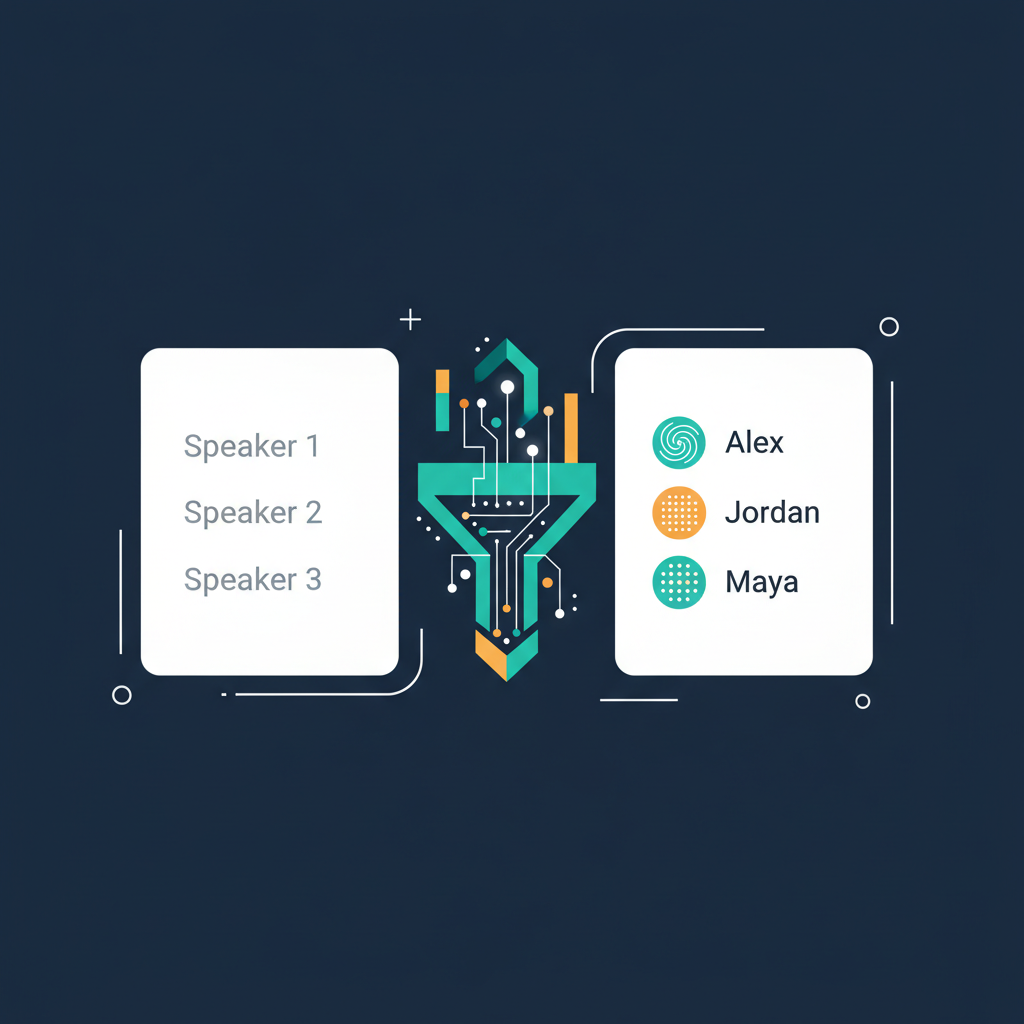
Speaker identification across the entire engagement. Estate planning typically involves the testator, a spouse, sometimes adult children, sometimes a financial advisor or CPA. AmyNote tags each speaker with cross-session memory, so the same daughter who attended meeting two is recognized in meeting four. You do not have to relabel "Speaker 1" every time.
Searchable longitudinal record. Anthropic's Claude Opus powers semantic search across the full engagement. An associate preparing a 2031 amendment can ask "what did the client say about her son David's spending habits?" and surface the relevant moments from 2024 meetings, not just keyword matches on the name "David." The reasoning is retrievable in minutes, not rebuilt in hours.
Privacy that respects privilege. Both OpenAI and Anthropic contractually guarantee zero training on user data. Audio is encrypted in transit; processing copies may be retained to deliver and recover requested features. Transcripts stay on the attorney's device with encrypted transport. Cloud processing copies are handled under the controls described in AmyNote’s Privacy Policy. No estate planning narrative feeding into model training pipelines. This is the baseline any serious trusts-and-estates practice should demand before any tool gets anywhere near a client meeting.
The shift is straightforward: instead of redoing discovery every time a client returns, the next attorney walks in already knowing the family.
What It Looks Like in Practice
Consider the same client from the opening. Six hours across four meetings. Now every conversation is captured verbatim, speaker-tagged, and searchable. When the grandson is born eight years later and her call routes to a new associate, the associate spends ten minutes before the meeting reviewing the original 2026 transcripts. She already knows about the estranged son. She already knows about the vacation house, and that it was her late husband's build. She already knows the tone in which the client talked about her stepdaughter.
The client does not have to retell the story. The senior partner does not have to be paged for context. The amendment is drafted from informed judgment, not reconstructed fragments. And when that associate eventually leaves, the family's story stays with the firm, not with her.
This is not a cosmetic upgrade. For a multi-generational planning practice, it is the difference between a firm that compounds client relationships and one that starts from zero every time a life event lands in the inbox.
Getting Started
AmyNote captures the full trust-planning conversation, preserves the reasoning behind every clause, and makes a decade of client meetings searchable in seconds. Transcription runs on OpenAI's latest Speech API. Analysis runs on Anthropic's Claude Opus. Both providers contractually guarantee zero training on user data. Transcripts stay on your device, encrypted in transit.
Three-day free trial, no credit card required. Try amynote.app. The next associate to amend your client's trust will thank you.
Originally published as an X Article.