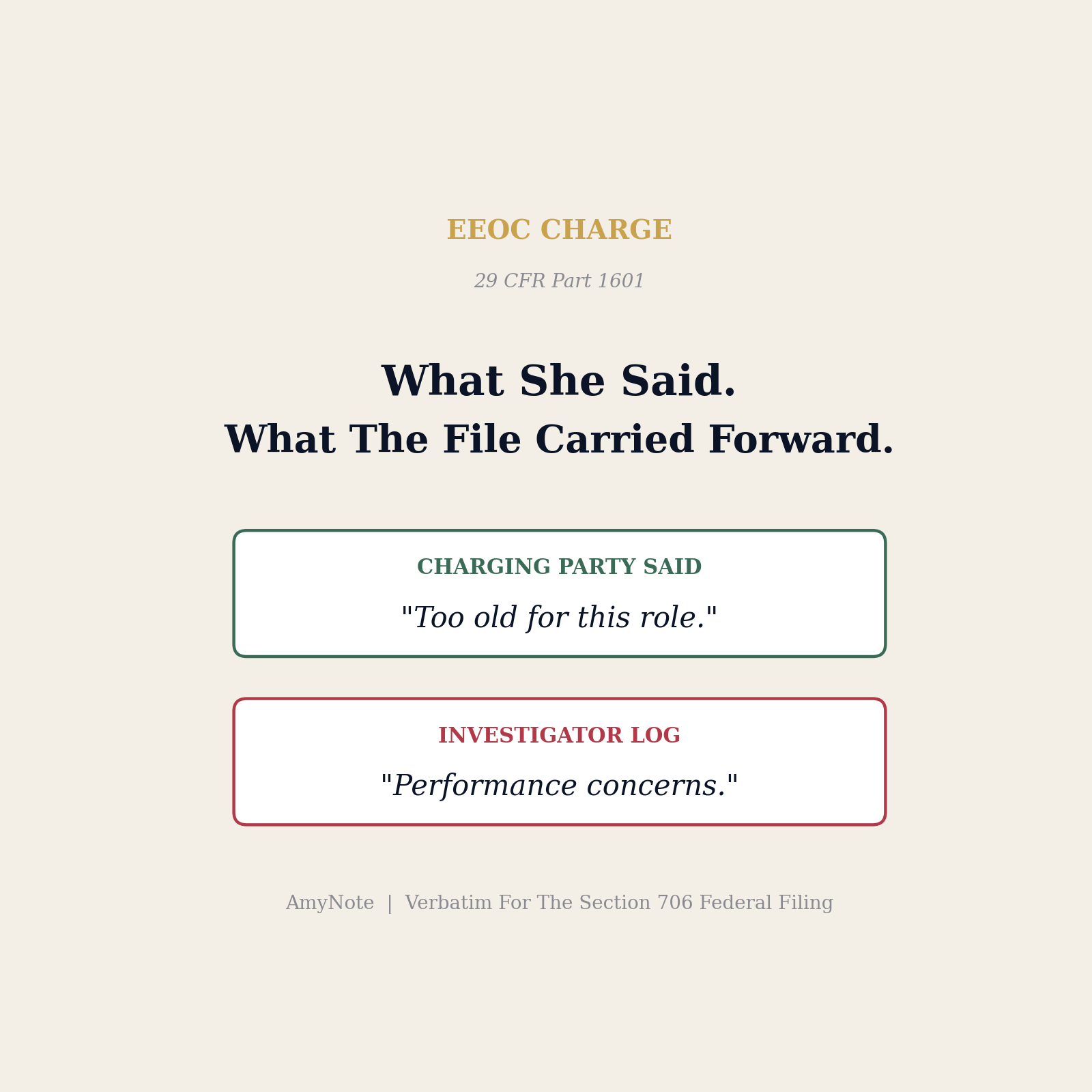
A federal employee sits down with an EEO Counselor and describes eight months of what she believes is discrimination. She mentions a reassignment, two denied training requests, and a performance rating. Nobody records the conversation.
Fifteen days later the Counselor files a written report summarizing “the issues discussed.” That summary becomes the outer boundary of everything she is allowed to litigate.
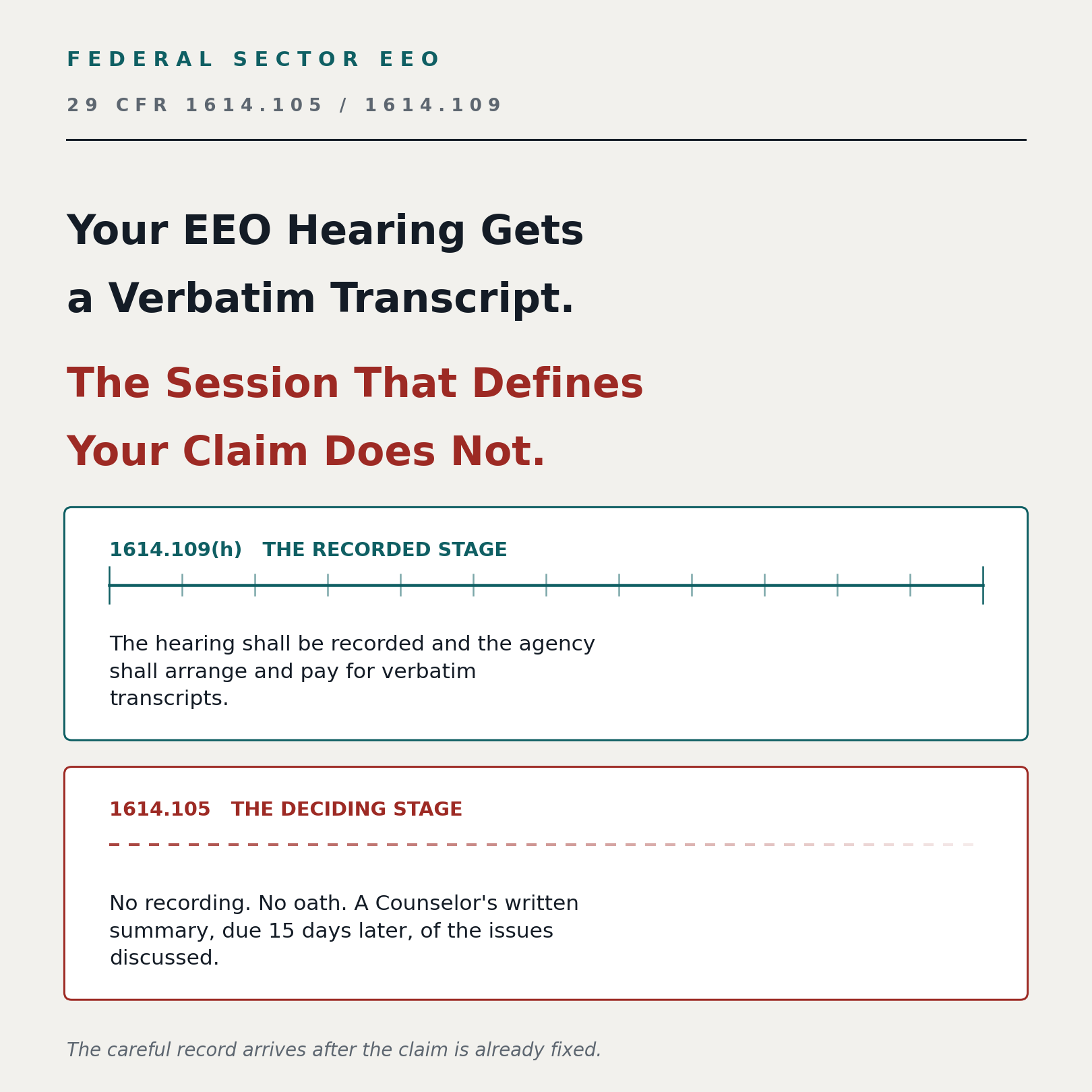
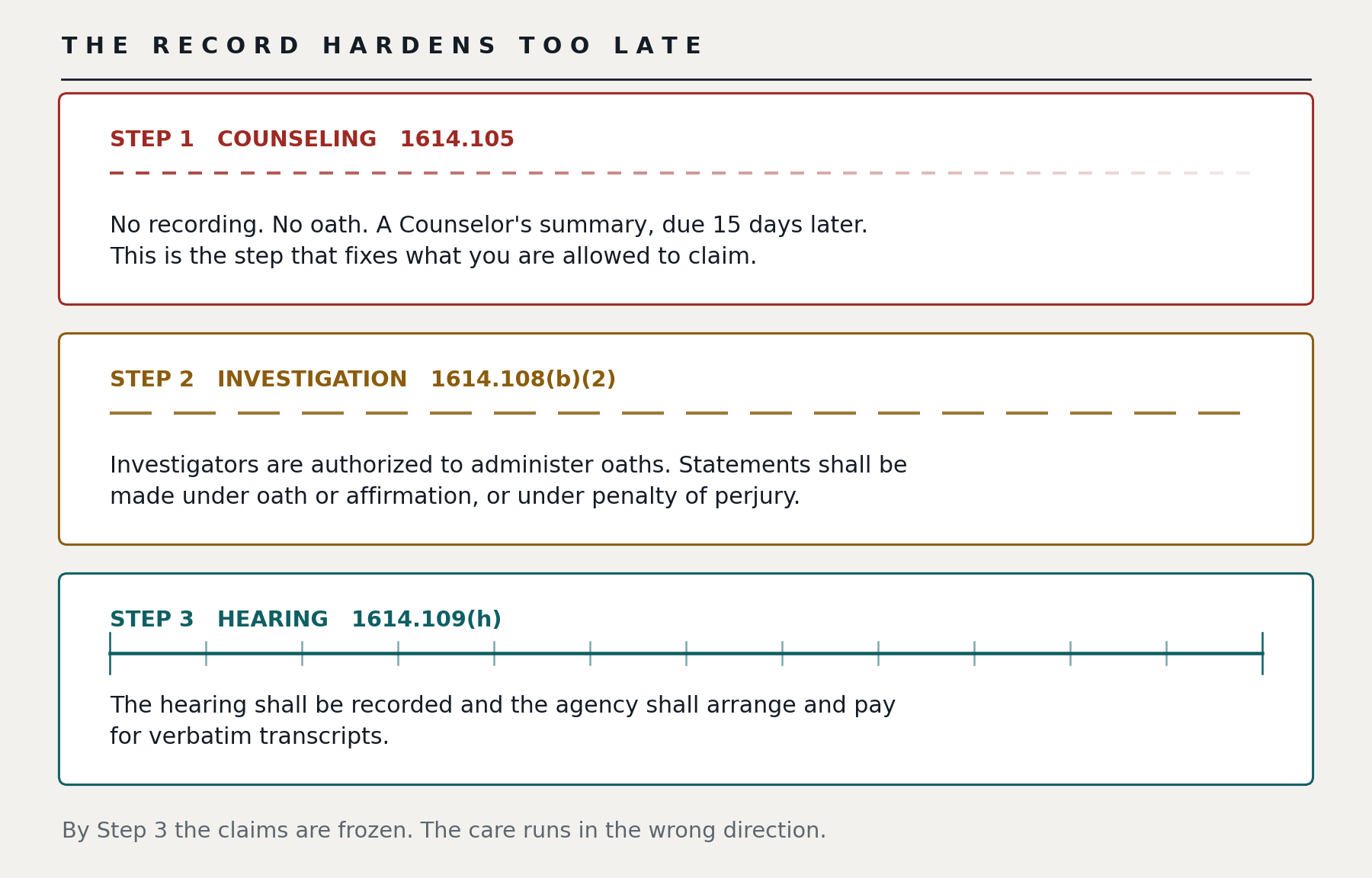
If the federal sector simply did not care about spoken words, that would at least be coherent. It plainly does care. Part 1614 requires a word-for-word transcript, arranged and paid for by the agency, at the hearing stage. It authorizes oaths at the investigation stage. The care is real — it just arrives after the only conversation that decides what the case is allowed to be about.
The Only Stage With No Record Is the Stage That Locks Your Claim
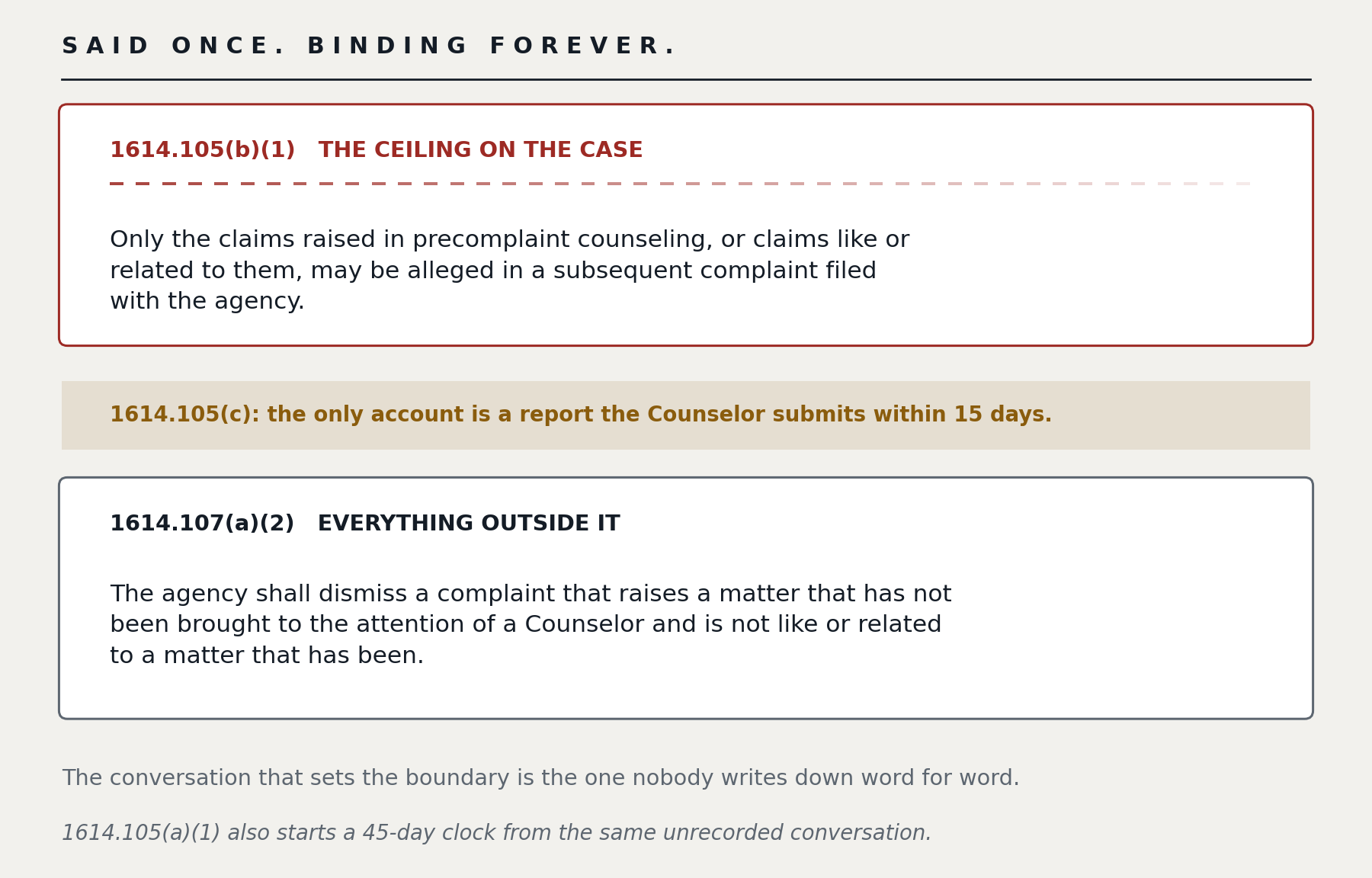
29 CFR 1614.105(b)(1) is blunt about it. Counselors must advise individuals in writing that only the claims raised in precomplaint counseling, or claims “like or related to” those claims, may be alleged in a subsequent complaint filed with the agency.
29 CFR 1614.107(a)(2) supplies the consequence. The agency shall dismiss a complaint that “raises a matter that has not been brought to the attention of a Counselor and is not like or related to a matter that has been brought to the attention of a Counselor.”
Note the verb. Not may dismiss after weighing the equities. Shall dismiss. The scope of the case is fixed by what was said out loud, once, in a room — and the only account of that room comes from 1614.105(c), under which the Counselor “shall submit a written report within 15 days” describing the issues discussed and actions taken during counseling.
That record is a summary, not a transcript. The employee whose claim it defines never drafts a word of it.
What the Fifteen-Day Report Is, and Is Not
The document doing all this work deserves a closer look, because its limits are structural rather than anyone’s fault. The 1614.105(c) report is written by the Counselor, for the agency, to close out the counseling stage. Its subject is the issues discussed and the actions taken. It is a competent administrative summary and it is not trying to be anything more. Nothing in the provision requires it to quote the employee, to enumerate every incident raised, or to be reviewed by the person it describes before it is filed.
Which means the employee is in an unusual position. The document that caps her case is authored by someone else, is a paraphrase rather than a record, and may be the first thing she disagrees with only after the cap has already taken effect. There is no provision anywhere in 1614.105 giving her a right to correct it, supplement it, or attach her own account to it.
And the stage moves quickly. Under 1614.105(d), the Counselor conducts a final interview within 30 days, after which the aggrieved person has 15 days from receiving the notice to file a formal complaint. The window in which to notice that an issue is missing from the summary, and to do something about it, is short and it closes on paper.
The Clock Runs on Memory Too
Under 1614.105(a)(1), an aggrieved person must initiate contact with a Counselor within 45 days of the matter alleged to be discriminatory, or within 45 days of the effective date of a personnel action. Miss it, and 1614.107(a)(2) dismisses the complaint.
Relief exists, but it is evidentiary. 1614.105(a)(2) extends the 45 days only when the individual shows one of a short list of things:
- Not notified of the time limits and not otherwise aware of them.
- Did not know, and reasonably should not have known, that the matter occurred.
- Prevented by circumstances beyond her control despite due diligence.
Every one of those doors opens on a factual showing about what a person knew and when. The usual proof is one human being’s recollection, offered months later, against an agency file.
1614.604(f) adds that the time limits in the part are subject to waiver, estoppel and equitable tolling — a genuine safety valve, and worth knowing about. But read it for what it asks of you: each of those doctrines is argued on facts about conduct, notice and diligence. An employee invoking equitable tolling is asking a decision-maker to believe a sequence of events, and the employee with a dated, contemporaneous account of it is making a different argument than the one describing it from memory, even when both are telling the truth.
Part 1614 Gets Careful, Just Too Late
At investigation, 1614.108(b)(2) provides that “Investigators are authorized to administer oaths,” and that statements of witnesses “shall be made under oath or affirmation or, alternatively, by written statement under penalty of perjury.”
At hearing, 1614.109(h) is emphatic: “The hearing shall be recorded and the agency shall arrange and pay for verbatim transcripts.”
The government buys a word-for-word record at the stage where the claims are already frozen, and buys nothing at the stage where the claims are chosen. Counseling is the only step that can quietly narrow a case, and the only one with no verbatim record.
Why the Obvious Fixes Do Not Hold
The intuitive responses each fail for a different reason, and the reasons are worth separating.
- “Like or related” is not a safety net you can plan around. It is the standard a decision-maker applies afterward to claims you did raise. It does not rescue an incident that was never mentioned, and whether something was mentioned is settled by a summary you did not write.
- The Counselor is not your record-keeper. Counseling is an agency function performed by an agency employee. The 1614.105(c) report serves the process, not the complainant, and nothing obliges it to preserve your framing of events.
- Later stages do not reopen the scope. The oaths at 1614.108(b)(2) and the transcript at 1614.109(h) produce excellent records of a case whose boundaries were drawn earlier. Better evidence about an excluded claim is still evidence about an excluded claim.
Build the Record the Regulation Does Not Give You
One provision already helps, and it is underused. 1614.605(a) grants the complainant the right to be accompanied, represented and advised by a representative of her choice at any stage, including the counseling stage. Bring someone. A second person in the room is the cheapest corroboration available, and the regulation explicitly invites it.
The stronger habit is a dated account of your own, captured while the session is fresh. Not a transcript — you are not going to get one — but a same-day record of what you raised, in what order, and in what words. The value is narrow and real: when the Counselor’s summary omits the training denials, the question becomes whether they were raised at all, and you want to answer that from something other than memory.
AmyNote is built for that. Transcription runs on OpenAI’s latest Speech API, which holds up on the vocabulary this process actually uses: reassignment, reprisal, “like or related,” 45-day contact, Counselor’s report, agency acronyms and case numbers. Speaker identification carries across sessions, so each conversation stays attributable instead of blurring into one undated memory. Anthropic’s Claude Opus adds structured summaries and semantic search across every session, which is how you answer “did I ever raise the training denials” without replaying an hour of audio.
Two honest limits. Recording the Counselor requires checking applicable consent law and your agency’s own policy first — this is not a suggestion to record a federal employee without clearing it. And a voice memo made afterward is not a transcript of the session. It is dated, detailed and yours, which is more than 1614.105(c) gives you, but those are different things.
On privacy, AmyNote states plainly that it does not use customer data to train AI models and does not sell content. Audio and text are encrypted in transit with TLS, and the saved library of recordings, transcripts and notes lives on the employee’s own iPhone or iPad. AmyNote is equally plain about the limit: local-first is not local-only, and when transcription or an AI summary runs, a processing copy may be retained on its cloud so the request can complete. For a file about your own employer, a vendor that writes its own caveat down beats one that leaves it to be discovered.
Getting Started
The 45-day clock starts before anyone tells you it has, and the claim scope closes before anyone shows you the summary.
Record your own account of every EEO conversation the same day it happens, and keep it searchable. Bring a representative under 1614.605(a) while you are at it. AmyNote does the first part in a few taps, supports over 120 languages with real-time translation, and the trial needs no credit card.
Part 1614 is not going to grow a transcript requirement before your final interview. The account on your side of the table is the part still within reach.
Originally published as an X Article by @AmyNoteApp.